
In the heart of the Sunshine State, your air conditioner doesn’t age in calendar years; it ages in work hours. While a unit in a milder climate might coast for two decades, the reality of how long does an ac unit last in florida is typically just 10 to 12 years. This shorter lifespan is the direct result of our systems running nearly 24/7 to combat the intense Central Florida humidity. We understand the stress that comes with an aging unit, especially when you’re facing high energy bills or the fear of a total system failure during an Orlando heatwave.
At RMI Heating and Air Conditioning, we’ve provided trusted cooling services since 2006, and we believe your comfort should always come first. This 2026 homeowner’s guide explains why Orlando and Kissimmee units retire earlier and how you can protect your investment. We’ll explore the impact of new refrigerant regulations, realistic replacement costs, and the professional strategies needed to keep your home cool. You’ll learn exactly how to determine if your system is ready for retirement or if a professional tune-up can keep it running efficiently for a few more seasons.
Key Takeaways
- Understand the realistic timeline for how long does an ac unit last in florida and why the 10-year mark often signals a sudden “efficiency cliff.”
- Learn the “Rule of 5,000” to decide if a repair is a sound investment or if it’s time to upgrade to a high-efficiency SEER2 system.
- Identify the “silent killers,” such as formicary corrosion and biological growth, that can cause your system to fail during a summer heatwave.
- Master simple, proactive strategies like the “1-Inch Rule” to protect your compressor and keep your monthly energy bills under control.
- Discover how RMI’s professional maintenance plans and fully stocked service trucks provide the reliability you need to stay cool all year long.
The Realistic AC Lifespan in Central Florida (2026 Update)
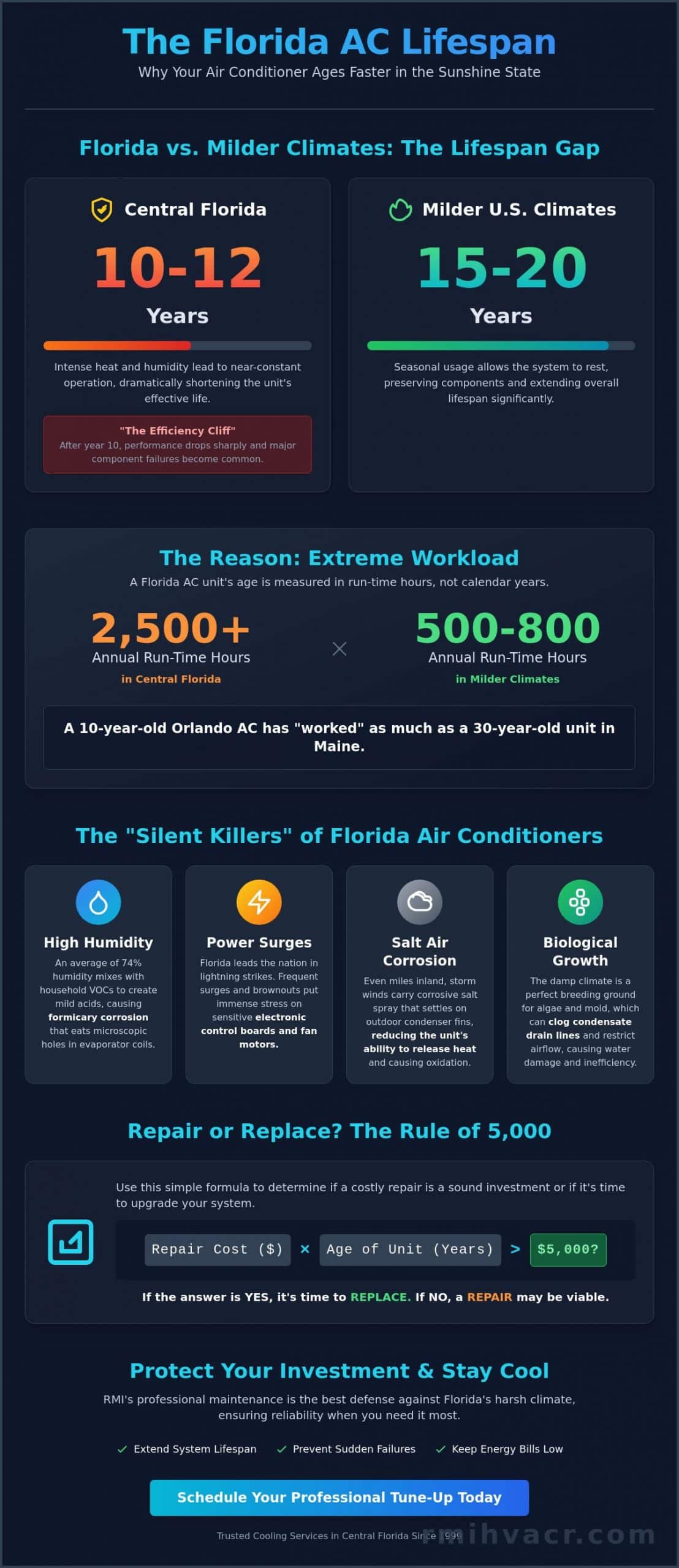
In many parts of the country, a well-maintained Heating, ventilation, and air conditioning (HVAC) system can reach its 20th birthday. In the Sunshine State, that timeline is a myth. For homeowners in Orlando and Kissimmee, the realistic answer to how long does an ac unit last in florida is typically 10 to 12 years. We define the Florida AC Lifespan as a function of total run-time hours under extreme load rather than the number of years on the manufacturer’s label. Understanding how long does an ac unit last in florida helps you budget for the future rather than being surprised by a sudden breakdown.
Between years 10 and 12, most local systems hit an “Efficiency Cliff.” This is when major components like the compressor, fan motors, and capacitors begin to fail in quick succession. While your unit might still blow air, its ability to remove humidity and maintain a set temperature drops significantly. This often leads to a cycle of expensive repairs that provide only temporary relief.
Why National Averages Don’t Apply to Orlando Homes
Why National Averages Don’t Apply to Orlando Homes
The math is simple but brutal for your equipment. A homeowner in a northern state might run their AC for 500 to 800 hours per year. In Central Florida, our units often exceed 2,500 run-time hours annually. This constant operation puts immense strain on compressor valves and fan motors. By the time an Orlando unit is 10 years old, it’s effectively “worked” as much as a unit in Maine would over 30 years. While Orlando and Kissimmee are spared the heavy salt air corrosion found on the coast, our inland heat still forces systems to work twice as hard. For readers in coastal areas like Southwest Florida, Ultra Air Heating and Cooling provides similar specialized support for systems facing extreme salt exposure. You can count on the experts at RMI Heating and Air Conditioning to provide a clear assessment of your unit’s true mechanical age.
Lifespan by System Type: Central AC vs. Heat Pumps
Traditional central AC split systems generally last 10 to 12 years when properly maintained. Heat pumps, however, might see slightly shorter lifespans. Because heat pumps provide both cooling and heating, they cycle year-round without the rest a furnace-based system gets in the winter. This continuous usage pushes them toward the 10-year mark for replacement. Modern systems with higher SEER2 efficiency ratings are built with more durable components, but they still require a consistent maintenance plan to survive the Florida elements. If your current system is over a decade old, exploring an air conditioning replacement can prevent the stress of a total failure during a summer peak.
The “Silent Killers” of Florida Air Conditioners
While the clock is always ticking on your equipment, specific environmental factors act as silent killers that accelerate mechanical wear. Understanding these threats helps explain how long does an ac unit last in florida compared to more temperate regions. Central Florida’s environment is uniquely hostile to mechanical equipment, combining corrosive air with extreme electrical instability. Biological growth like algae and mold also thrives in our damp climate, frequently clogging condensate drain lines and reducing airflow efficiency.
Florida leads the nation in lightning strikes and power fluctuations. Frequent brownouts and surges put immense stress on sensitive electronic control boards and fan motors. Even if your home is in Orlando or Kissimmee, miles from the coast, tropical storms and hurricanes can carry microscopic salt spray inland. This salt settles on your outdoor condenser fins, accelerating oxidation and reducing the unit’s ability to release heat. Following official AC maintenance tips is the best defense against these external threats. This is why many residents ask how long does an ac unit last in florida when they notice their systems struggling after a particularly rough storm season.
High Humidity and Coil Corrosion
Central Florida averages 74% relative humidity, which creates a constant state of moisture inside your air handler. Humidity is a mechanical load, not just a comfort issue. When this moisture mixes with common household volatile organic compounds (VOCs) from cleaners or air fresheners, it creates a mild acid. This acid causes formicary corrosion, which eats microscopic tunnels through copper evaporator coils. These “pitting” leaks are difficult to patch and often signal that the system is reaching the end of its useful life. If you notice your unit running constantly without reaching the set temperature, an expert air conditioning repair technician can check for these hidden leaks.
Extreme Heat and Component Stress
The heat in a Florida attic can easily exceed 140°F during the summer peaks. This extreme environment places a massive thermal load on your ductwork and air handler components. Capacitors, the small components that provide the energy to start your motors, are particularly sensitive to high temperatures. They are frequently the first parts to fail during a heatwave. This heat also contributes to “Short Cycling,” where the system turns on and off too frequently. This rapid cycling wears out the compressor valves and fan motors long before their time. Ensuring your system is properly sized and maintained helps mitigate this stress, giving you cooling you can count on even in the hottest months.
Repair vs. Replace: Signs Your Unit is on Its Last Leg
Every homeowner eventually faces the stressful dilemma of whether to patch up an old system or invest in a new one. While we’ve established the environmental factors affecting how long does an ac unit last in florida, your bank account often provides the clearest signal that a change is needed. A unit that technically “works” but runs 24/7 to keep up with the Orlando heat is often costing you more in monthly energy waste than the monthly payment on a modern system. If you’re seeing these warning signs, it’s time to consider an air conditioning replacement to regain your peace of mind.
We often see a pattern of “nickel-and-dime” repairs that precede a total breakdown. It starts with a capacitor in July, followed by a fan motor in August, and then a refrigerant leak in September. These cumulative costs quickly add up, and they don’t solve the underlying issue of an aging, inefficient compressor. In 2026, with the transition to newer refrigerants like R-454B, keeping an old system alive is becoming increasingly expensive as parts for older models become harder to source.
The Rule of 5,000 Explained
To help our customers make an objective decision, we recommend using the “Rule of 5,000.” You simply multiply the age of the unit by the cost of the current repair quote. If the result is over 5,000, it’s generally a better investment to move forward with a new AC installation. For example, a $500 repair on a 12-year-old unit equals 6,000. In this scenario, you’re better off putting that money toward a new, warrantied system rather than patching a unit that has already reached the end of its expected Florida lifespan.
Performance Red Flags You Can’t Ignore
- Skyrocketing Energy Bills: If your monthly cooling costs have increased by 20% or more compared to last year without a rate hike, your unit is likely losing its mechanical efficiency.
- Inconsistent Cooling: Humidity “pockets” or rooms that stay five degrees warmer than the rest of the house indicate that the system can no longer move air effectively.
- Mechanical Noises: Grinding, squealing, or loud banging sounds from the outdoor condenser often point to failing bearings or a compressor on the verge of seizure.
- R-22 Obsolescence: If your unit still uses R-22 refrigerant, any leak is a signal to replace. The cost of this phased-out chemical is prohibitive, and those funds are better spent on a modern SEER2 system.
Our team at RMI Heating and Air Conditioning has helped Central Florida families navigate these decisions since 2006. We prioritize your comfort and won’t recommend a replacement if a simple, reliable repair will suffice. You can count on us for an honest assessment of your system’s health.
Proven Strategies to Extend Your AC Unit’s Life
You aren’t powerless against the Florida climate. While the environment is harsh, your daily and seasonal choices directly dictate how long does an ac unit last in florida. We’ve seen well-maintained units defy the 10-year average simply because the homeowners stayed ahead of minor issues. The most effective strategy is the “1-Inch Rule.” You must change your 1-inch pleated air filters every 30 days. A clogged filter restricts airflow; this makes your blower motor work 15% harder and eventually overheats the compressor. It’s a simple task that prevents a very expensive failure.
Another critical task is clearing your condensate drain line. Florida’s high humidity produces gallons of water daily as your AC de-humidifies your home. Algae thrives in these warm, wet pipes. We recommend pouring 1/4 cup of distilled white vinegar down the drain line every three months to kill biological growth. This prevents clogs that lead to water damage or trigger automatic system shut-offs. Keeping the area around your outdoor condenser clear of debris also ensures the system can release heat efficiently.
The Critical Role of Professional Maintenance
Professional intervention is non-negotiable if you want your system to survive a decade of 24/7 operation. Our maintenance plans focus on the components that Florida heat kills first. We meticulously clean the evaporator and condenser coils; even a thin layer of dust acts as an insulator that prevents heat transfer. We also verify refrigerant levels to prevent “slugging.” This occurs when incorrect pressure allows liquid refrigerant to enter the compressor, which can cause instant, catastrophic failure. Scheduling regular AC maintenance before the summer peak ensures your system is prepared for the 2,500-hour annual run-time common in Orlando.
Homeowner Best Practices for 2026
Modern technology makes it easier to protect your equipment. We suggest using smart thermostats to manage run-times. You don’t need to turn the AC off; instead, raising the temperature by 4 degrees when you’re away reduces the total mechanical load. Outside, you must maintain a 3-foot clearance around your condenser unit. Florida’s vegetation grows quickly, and vines or shrubs can choke off the airflow your unit needs to breathe. Finally, ensure your outdoor unit isn’t directly blasted by lawn sprinklers. The minerals in Florida’s reclaimed water can cause premature corrosion on the delicate aluminum fins. Ready to protect your investment? Schedule your professional AC tune-up with RMI HVACR today to ensure your cooling is something you can count on.
Trusting RMI for Your Central Florida AC Needs
RMI HVACR has served Orlando, Kissimmee, and the surrounding Central Florida communities since 2006. We understand that your air conditioner is the most important appliance in your home. When you’re researching how long does an ac unit last in florida, you aren’t just looking for a number; you’re looking for a way to avoid a breakdown in 95-degree weather. Our signature “Cooling You Can Count On” is built on over 25 years of local experience. We maintain a fleet of fully stocked trucks that arrive at your door equipped with the most common parts and tools. This preparedness allows our certified experts to solve most issues on the first visit, saving you time and stress.
Expert Assessments, Not Sales Pitches
We operate with a strict “Repair First” philosophy. Our technicians are trained to find the most cost-effective way to keep you comfortable. We won’t suggest a replacement if a reliable repair can extend your system’s life. We understand the specific environmental threats in the Orlando area, from the “silent killers” like formicary corrosion to the impact of frequent brownouts. If you’re facing a cooling crisis at 2:00 AM, our emergency AC repair team is available 24/7. For all other service requests, we schedule promptly to ensure your comfort always comes first.
Ready for a Reliable Upgrade?
Eventually, even the best-maintained unit reaches the end of its functional life. We help homeowners navigate the 2026 transition to high-efficiency SEER2 systems and the latest low-GWP refrigerants. Our estimates are free and feature transparent, upfront pricing. We don’t use generic sizing charts. Instead, we calculate your home’s specific heat-load and humidity-removal requirements based on Florida’s average relative humidity levels. This custom approach ensures your new system runs efficiently and lowers your monthly bills. Contact RMI HVACR today for an expert system health check and get a realistic answer on how long does an ac unit last in florida for your specific equipment.
Secure Your Home’s Cooling Future
Navigating the unique challenges of the Sunshine State requires a proactive approach to your home’s most vital system. While the question of how long does an ac unit last in florida typically leads to a 10 to 12-year benchmark, your choices today determine which side of that average you fall on. Using tools like the Rule of 5,000 and committing to monthly filter changes helps you avoid the “Efficiency Cliff” that catches many homeowners off guard. You don’t have to wait for a total system failure in the middle of July to start planning for your next high-efficiency upgrade; similarly, for those who manage community associations, you can discover My Florida HOA Manager for expert resources on maintaining financial stability through professional budget management.
RMI HVACR has been the trusted expert for Central Florida families since 2006. Our A+ rated team is dedicated to providing cooling you can count on, backed by 24/7 emergency availability and a deep understanding of our local climate. Whether you need a simple tune-up to extend your current unit’s life or a transparent estimate for a modern SEER2 installation, we’re here to help. Schedule Your Expert AC Health Check with RMI Today to ensure your family stays comfortable regardless of the temperature outside. We look forward to putting our expertise to work for your home.
Frequently Asked Questions
Is 10 years old considered “old” for an AC unit in Florida?
Yes, 10 years is the point where most Florida air conditioners enter the “retirement” phase. While units in northern states might reach 15 or 20 years, the 2,500 annual run-time hours in Central Florida put a decade-old system at the end of its reliable lifespan. You can expect more frequent part failures and higher energy bills as the mechanical components reach this stage of wear.
Does salt air affect AC units in inland cities like Orlando?
Yes, salt air travels up to 50 miles inland during tropical storms and hurricanes, affecting homes in Orlando and Kissimmee. Microscopic salt particles settle on aluminum condenser fins, leading to oxidation and reduced heat transfer. While the impact is less severe than beachfront properties, inland units still face corrosion that shortens their operational life compared to systems in states without coastal exposure.
Can I extend my AC life by running it less often?
Reducing run-time helps, but it’s more effective to manage the load through efficiency rather than turning the unit off. High humidity levels in Florida can lead to mold growth if the AC stays off for extended periods. Instead, use a smart thermostat to raise the temperature by 4 degrees when you’re away. This reduces mechanical wear on the compressor without compromising your indoor air quality.
What is the most common cause of AC failure in Florida?
Electrical component failure and compressor burnout are the leading causes of system death in our region. Florida’s frequent lightning strikes and power surges damage sensitive control boards and capacitors. Additionally, poor maintenance leads to dirty coils, which forces the compressor to run at higher temperatures. This constant overheating eventually causes the internal motor windings to fail, resulting in a total system breakdown.
Is it worth repairing an 8-year-old AC unit?
It depends on the repair cost, but generally, repairs under $500 are worth the investment for an 8-year-old system. Use the Rule of 5,000: multiply the age by the repair cost. If the total is under 5,000, proceed with the fix. However, if the unit requires a new compressor or uses phased-out R-410A refrigerant, replacing it with a modern SEER2 system is often the smarter financial move.
How much does a new AC unit typically cost in Florida in 2026?
The average cost for a new central air conditioning system in Florida ranges from $5,850 to $12,000 as of May 2026. This price reflects the industry-wide transition to lower-GWP refrigerants like R-454B and stricter SEER2 efficiency standards. While this is an increase from 2024 levels, homeowners can offset the cost using federal tax credits of up to $600 for central AC or $2,000 for heat pumps.
How often should I have my AC serviced in Florida?
You should have your system professionally serviced at least twice per year to maintain peak efficiency. A spring tune-up prepares the unit for the heavy summer load, while a fall check ensures the heating components are safe for occasional cold snaps. Regular maintenance is essential for determining how long does an ac unit last in florida for your specific home, as it prevents minor issues from becoming catastrophic failures.
What happens if I don’t change my air filter every month?
Failing to change your filter monthly leads to restricted airflow, which is the primary cause of frozen evaporator coils and blower motor failure. A dirty filter forces your system to consume 15% more electricity to move the same amount of air. Over time, this added stress shortens the life of the compressor and leads to expensive repairs that could have been avoided with a simple filter replacement.