
In the 95-degree humidity of a Florida summer, a 12-year-old air conditioner isn’t just an appliance; it’s a ticking financial clock. You’ve likely felt the frustration of watching your monthly utility bills climb while your system struggles to keep up with the heat. It’s common to feel stuck between the cost of another $750 repair and the major investment of a new installation. At RMI Heating and Air Conditioning, we understand that you need cooling you can count on without the stress of frequent breakdowns.
Using a professional ac repair vs replacement calculator approach helps take the guesswork out of these high-stakes decisions. Since 2006, we’ve provided the expert guidance you need to choose between fixing or replacing your system. This guide uses the industry-standard $5,000 rule and updated 2026 Florida data to show you exactly when to stop patching up old equipment. We will preview how the mandatory shift to R-32 refrigerants and 14.3 SEER2 minimum standards impact your home, showing you how a modern system can slash your annual cooling costs by nearly 50%.
Key Takeaways
- Learn how to apply the industry-standard $5,000 rule to determine if a repair is a sound investment or a significant financial risk for your home.
- Use our data-driven ac repair vs replacement calculator approach to weigh the 50% energy savings of new SEER2 systems against the rising costs of older units.
- Discover how to maximize your ROI with federal tax credits up to $2,000 and local Central Florida utility rebates that lower the cost of high-efficiency upgrades.
- Understand how unique Florida stressors like salt air corrosion and frequent lightning strikes accelerate the wear on your system’s critical components.
- Find out how a professional diagnostic visit provides the transparent, side-by-side quotes you need to make a confident decision for your long-term comfort.
The $5,000 Rule: The Industry Standard for AC Repair vs. Replacement
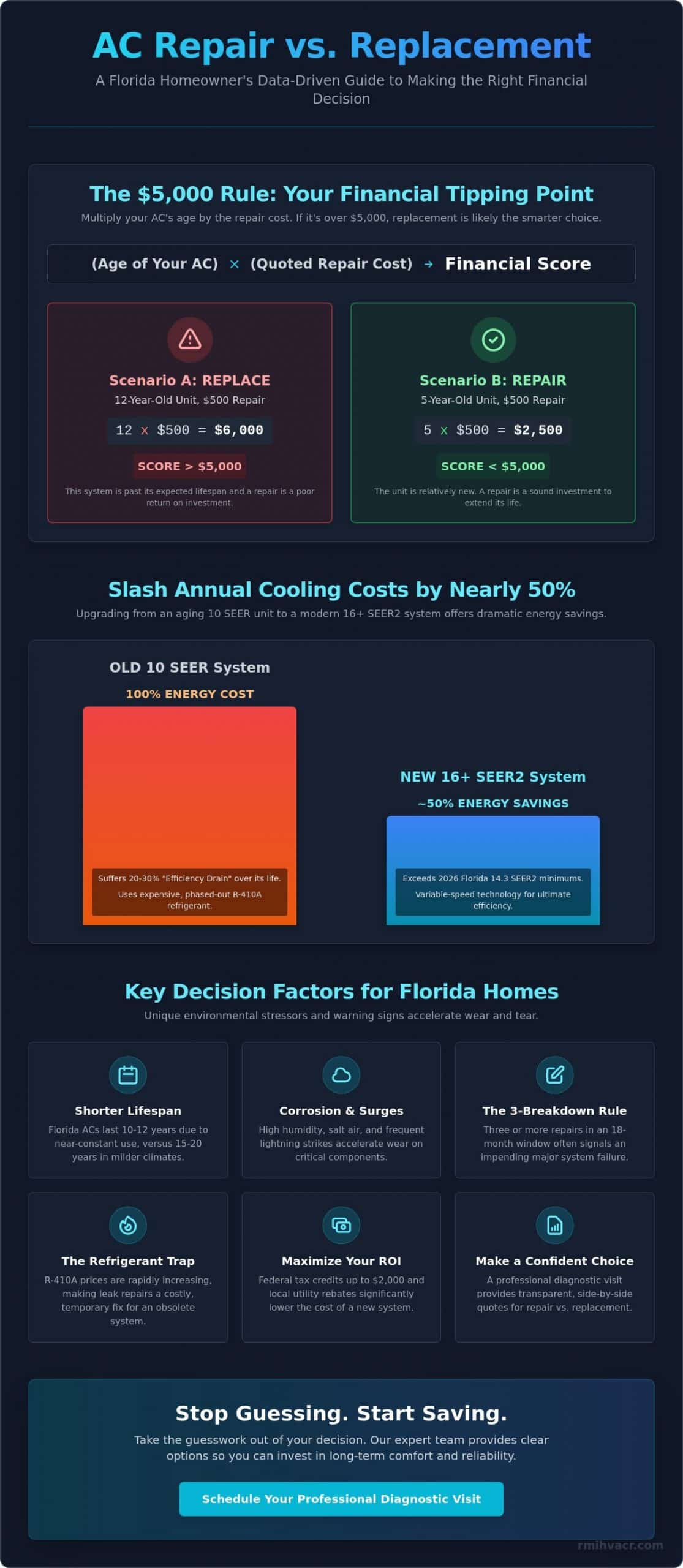
Deciding whether to sink money into an aging unit or invest in a new system is a common headache for homeowners. To simplify this, industry experts use a mathematical formula known as the $5,000 rule. This serves as a manual ac repair vs replacement calculator to help you see the long term value of your decision. The calculation is straightforward: multiply the age of your air conditioner by the quoted cost of the repair. If the total exceeds $5,000, the data suggests that replacement is the more financially responsible choice.
This $5,000 threshold represents the mathematical tipping point where the return on investment for a repair starts to vanish. Older units often operate with a lower Seasonal Energy Efficiency Ratio (SEER); this means they use more power to provide less cooling compared to modern standards. For example, a 12-year-old unit requiring a $500 repair results in a score of $6,000. Because that system is likely near the end of its functional life and costing you more in monthly utilities, that $500 is better spent as a down payment for a new, high-efficiency model. Contrast this with a 5-year-old unit needing the same $500 repair. The score is only $2,500, which is well below the threshold. In that case, a repair is a sound investment that protects your current system and keeps you comfortable.
Why Age Matters More in Central Florida
In Central Florida, the average AC system lasts 10 to 12 years due to high humidity and near-constant operation. While a unit in a northern state might last 15 to 20 years, systems in the Orlando-Kissimmee-Sanford corridor work significantly harder. A 10-year-old unit here has roughly the same run hours as a 15-year-old unit in a milder climate. If your system is approaching the decade mark, it has already survived thousands of cycles in 90-degree heat, and its internal components are likely reaching their wear limits.
The Three Breakdown Rule
We often see homeowners fall into a cycle of nuisance repairs that eventually lead to catastrophic failure. These are small fixes like capacitor replacements or contactor issues that seem manageable at first. However, if you’ve needed three minor repairs within an 18-month window, your system is likely signaling an impending major component failure, such as a compressor or evaporator coil leak. Investing in professional AC maintenance can help catch these issues early. Once the cycle of frequent breakdowns begins, the ac repair vs replacement calculator logic becomes your best guide for moving forward with a reliable solution.
Evaluating Efficiency: SEER2 Ratings and Your Energy Bill
The transition to SEER2 represents a major shift in how we measure cooling performance. As of 2026, all new systems in Florida must meet a minimum rating of 14.3 SEER2. This isn’t just a label change. It reflects a more rigorous testing standard that accounts for higher external static pressure, providing a more accurate look at how a unit performs in a real-world home. When you use an ac repair vs replacement calculator mindset, you have to factor in the “Efficiency Drain” of your current equipment. Most 10-year-old units cost 20% to 30% more to operate than they did on the day they were installed. This happens because of motor wear, debris in the coils, and minor refrigerant leaks that force the compressor to work harder.
Upgrading from an old 10 SEER system to a modern 16+ SEER2 unit can slash your monthly power bill significantly. You can find more details on Federal HVAC tax credits and rebates that make this transition more affordable. These monthly savings often pay for the price difference of a new unit within just a few years. Modern variable-speed technology allows the system to adjust its output to match your home’s needs exactly. This prevents the constant on-and-off cycling that wastes electricity and wears out components prematurely.
The R-22 and R-410A Refrigerant Trap
The days of cheap refrigerant repairs are over. R-22 was phased out years ago, and R-410A is now seeing rapid price increases as the industry moves toward low-GWP (Global Warming Potential) options. Starting in 2026, new equipment must use A2L refrigerants like R-454B. If your current unit has a leak, “topping it off” with R-410A is a temporary and expensive fix. For professional advice on navigating these refrigerant changes and exploring modern system options, you can visit Expert Air Florida. It’s often a better financial move to put that money toward a modern system that uses the latest, most sustainable refrigerants. Continuing to repair an R-410A system that’s over a decade old is often a losing battle against rising chemical costs.
Humidity Control: The Invisible Cost of Old ACs
In Central Florida, cooling is only half the battle; dehumidification is the other. As coils age and systems lose their original efficiency, they struggle to pull moisture from the air. This leads to that “sticky” feeling indoors and can even cause secondary costs like mold growth or wood rot. Modern high-efficiency AC installation often includes variable-speed blowers. These systems run longer at lower speeds, which is the most effective way to manage Florida’s intense humidity levels and keep your family comfortable. If you’re tired of high bills and a humid home, schedule a professional system assessment to see where your current unit stands.
Calculating ROI: Tax Credits, Rebates, and Long-Term Savings
When you use an ac repair vs replacement calculator, the initial price of a new system is only one part of the story. To find the true “Net Cost,” you have to subtract the financial incentives available in 2026. The Federal Section 25C tax credit is a major factor for many homeowners. This incentive can cover up to 30% of the project cost, often capped at $2,000 for qualified heat pumps or $600 for high-efficiency central air conditioning units. Since tax regulations can shift, we always recommend consulting a tax professional to confirm your eligibility for the current year.
Beyond federal assistance, Central Florida residents can access local utility programs that lower the barrier to entry for new technology. Companies like Duke Energy and OUC frequently offer rebates for homeowners who upgrade to SEER2-compliant systems. These rebates can range from a few hundred to over a thousand dollars depending on the specific efficiency rating. When you combine these credits with three years of lower energy bills, the “Strategic Replacement” often costs less over a five-year period than the “Repair-and-Wait” approach. Waiting for a total system failure usually means paying peak-season prices for emergency labor while missing out on limited-time rebates.
Strategic Planning vs. Panic Buying
Timing your installation can lead to substantial savings and a smoother experience. We often see more flexible scheduling and equipment availability during the “off-season” months of January and February. If you wait for a July breakdown, you’re often forced into a panic buy. This leads to limited inventory choices and the stress of a hot home. While our service vehicles arrive as “Fully Stocked Trucks” to handle urgent repairs, a custom AC replacement requires careful planning to ensure the new system is perfectly matched to your home’s ductwork and square footage.
Warranty Protection: Peace of Mind for 10+ Years
A major hidden cost of choosing repair over replacement is the lack of long-term financial protection. Most repairs come with a limited 30 to 90-day warranty on the specific part replaced. If a different component fails two months later, you’re back to paying full price for parts and labor. A new system includes a 10-year parts warranty that effectively “zeros out” your unexpected repair budget for a decade. This guarantee of reliable cooling is a vital safeguard during a Florida summer. At RMI HVACR, we’ve focused on building this kind of long-term trust since 2006, ensuring your comfort always comes first.
The Florida Factor: Environmental Stress on HVAC Systems
Living in Central Florida means your HVAC system faces environmental conditions that national guides simply don’t account for. While a generic ac repair vs replacement calculator might provide a baseline, it rarely weights the “Florida Factor” correctly. For homeowners in Lakeland or those closer to the coast, salt air corrosion is a silent killer. This salt-heavy moisture eats through aluminum fins and copper tubing, often shortening a system’s life by 3 to 5 years compared to inland units. Additionally, Central Florida remains the lightning capital of the United States. These frequent electrical storms create micro-surges that degrade sensitive electronics over time. Even if a strike doesn’t cause an immediate failure, it weakens control boards and capacitors, leading to those frustrating “mystery” breakdowns during the peak of summer.
Our climate also forces systems into a brutal, near-constant run cycle. When outdoor humidity levels hit 90%, your air conditioner works twice as hard to maintain a 75-degree interior compared to units in drier states. This relentless operation is why we perform a “Manual J” Load Calculation for every new project. This technical assessment ensures your system is perfectly sized for your home’s specific square footage, window orientation, and insulation levels. An oversized unit will short-cycle, turning on and off so frequently that it never stays running long enough to remove humidity. Getting the size right is the only way to avoid a clammy, uncomfortable home.
Indoor Air Quality (IAQ) and Your New System
Modern systems do more than just lower the temperature; they act as the heart of your home’s health. New SEER2-compliant equipment integrates seamlessly with advanced HEPA filtration and UV light systems designed to kill mold spores and bacteria. When we visit your home, we don’t just look at the outdoor condenser. We evaluate your entire duct system for leaks that might be pulling in hot, dusty attic air. If your ductwork is failing, even a major repair to the AC unit won’t solve your comfort or air quality issues. We look at the whole home to ensure your investment actually delivers results.
Reliability Since 2006: Why Local Expertise Matters
Since 2006, RMI Heating and Air Conditioning has served the Orlando, Kissimmee, and Sanford communities. Our technicians live where you do, and they understand the specific failure points caused by our local environment. We know how the intense heat in Kissimmee affects specific compressor brands and why Sanford homes often face unique drainage challenges due to high water tables. We’ve built our reputation on providing honest, data-driven advice that prioritizes your family’s long-term satisfaction. If you’re unsure if your current unit can survive another 95-degree afternoon, request a professional system evaluation from our expert team today. We provide the cooling you can count on.
Making the Decision: Next Steps with RMI Heating and Air Conditioning
Choosing between a major repair and a full replacement is a significant financial decision that impacts your home’s comfort for the next decade. While the ac repair vs replacement calculator logic provides a solid mathematical framework, a professional diagnostic visit from RMI Heating and Air Conditioning brings the practical clarity you need. Our certified experts perform a comprehensive inspection of your system’s critical components, including the compressor, evaporator coils, and electrical connections. We don’t just give you a single number; we provide transparent, side-by-side quotes that compare the immediate cost of a fix with the long term savings of a new system. This no-pressure approach ensures you have the data to choose what fits your family’s budget and cooling needs best.
We understand that a new HVAC system is a major investment. To help Central Florida families manage this transition, we offer flexible financing options that make high-efficiency, SEER2-compliant systems affordable. By spreading the cost into manageable monthly payments, you can start saving on your utility bills immediately without a massive upfront drain on your savings. Our goal is to provide a stress-free path to reliable cooling, backed by the same dependable service we have delivered since 2006; if you’re looking for similar expertise in the Maryland area, check out Flow Heating, Cooling & Plumbing Services.
Request a Free Estimate Today
If your system is still running but showing signs of age, schedule a free estimate to plan your next move strategically. Planning ahead allows you to avoid the “panic buy” during a mid-summer breakdown. However, if you’re currently without cooling in the 95-degree heat, we offer 24/7 emergency availability to restore your comfort. You can count on us for professional AC repair Orlando services. Our fully stocked trucks arrive ready to solve most common problems on the first visit.
Preparing for Your Installation
A standard system replacement typically takes one full day to complete. Our team takes great care to protect your property by using floor coverings and maintaining a clean workspace throughout the process. Once the new unit is in place, we perform a rigorous final testing and efficiency calibration phase. This ensures your system meets the 14.3 SEER2 minimum standard and provides the dehumidification necessary for the Florida climate. We verify every connection so you can enjoy the “Cooling You Can Count On” for years to come.
Secure Your Home’s Comfort and Efficiency
Navigating the choice between a quick fix and a total system upgrade doesn’t have to be stressful. By applying the $5,000 rule and considering the nearly 50% energy savings offered by modern 14.3 SEER2 systems, you can make a choice that protects your wallet and your home. Florida’s intense humidity and salt air demand a system that’s both durable and efficient. Using a professional ac repair vs replacement calculator mindset ensures you aren’t throwing money at a failing unit that will only break down again during the next heatwave.
At RMI HVACR, we’ve been a trusted partner for Central Florida homeowners since 2006. Our service vehicles arrive as fully stocked trucks, which means we’re prepared for any situation. Whether you need an urgent fix or a long-term upgrade, our 24/7 emergency service ensures we’re always here when you need us most. Schedule Your AC Diagnostic or Get a Free Replacement Estimate today to secure cooling you can count on. We look forward to helping you stay cool and comfortable all year long.
Frequently Asked Questions
Is it worth repairing a 15-year-old AC unit?
It is rarely worth repairing a 15-year-old unit in Central Florida. While the national average lifespan is 15 to 20 years, systems in our climate typically last only 10 to 12 years due to high humidity and near-constant run times. Investing in a major repair for a system at this age is often a temporary fix. We recommend using an ac repair vs replacement calculator approach to see how the cost of a new, efficient system compares to the ongoing expense of maintaining an aging one.
How much does a typical AC compressor repair cost in Florida?
A typical AC compressor repair in Florida often costs between $2,000 and $3,500 as of 2026. This is considered a major repair because the compressor is the heart of your system. Because this cost is so high, many homeowners find that putting that money toward a new system with a 10-year warranty is a more dependable long-term strategy. Our expert technicians provide transparent quotes so you can make a decision that fits your budget.
Can I still get parts for an R-22 air conditioner in 2026?
Finding parts for an R-22 air conditioner in 2026 is extremely difficult and expensive. The production and import of R-22 refrigerant ended on January 1, 2020, which caused the remaining supply prices to skyrocket. Most manufacturers have stopped producing compatible parts for these older systems. If your R-22 unit fails, a full system replacement is usually the only way to ensure your family has cooling they can count on during the summer.
How much can I save on my electric bill with a new SEER2 system?
You can reduce your annual cooling costs by nearly 50% by upgrading from an older 10 SEER unit to a modern 18 SEER2 system. The new SEER2 standards, which became mandatory in 2026, ensure that systems are tested under more realistic conditions. This means your new unit will use significantly less power to remove heat and moisture from your home. These monthly savings often help the new system pay for itself over its first few years of operation.
What is the $5,000 rule for HVAC?
The $5,000 rule is a simple formula where you multiply the age of your AC unit by the quoted repair cost. If the result is greater than $5,000, the industry standard suggests that replacement is the better financial choice. This ac repair vs replacement calculator logic helps you avoid the “money pit” cycle of frequent repairs on an aging system. It’s a reliable way to determine when a repair no longer provides a good return on your investment.
Does the 25C tax credit apply to all air conditioners?
No, the 25C tax credit only applies to specific high-efficiency systems that meet strict Department of Energy requirements. In 2026, this credit typically offers up to 30% of the project cost, capped at $600 for qualified central air conditioners and $2,000 for qualified heat pumps. Since these regulations can change, it’s a good idea to consult a tax professional. We can help you identify which systems qualify for these significant savings during your consultation.
How long does a typical AC replacement take to install?
A typical AC replacement usually takes between 8 and 14 hours to complete. Our certified experts arrive in fully stocked trucks to ensure the job is done right the first time without unnecessary delays. We focus on a meticulous installation process that includes removing your old equipment, installing the new SEER2-compliant unit, and performing a final efficiency calibration. Most residential projects are finished in a single day to restore your home’s comfort quickly.
What happens if I ignore a small Freon leak?
Ignoring a small refrigerant leak leads to higher energy bills and will eventually cause your compressor to burn out. When your system is low on refrigerant, it must work twice as hard to maintain a 75-degree interior. This extra strain wears out internal components and significantly increases your monthly utility costs. Since 2026 regulations require a transition to new refrigerants like R-32 or R-454B, repairing a leak in an old R-410A system is often an expensive, short-term fix.