
Furnace Blowing Cold Air? Causes and Fast Fixes for 2026
Imagine waking up during a rare Orlando cold snap only to find your vents pumping out a chilly breeze. It’s a stressful moment that often leads to immediate worries about gas leaks or the high price of a total system failure. You aren’t alone in this frustration. Many homeowners find that a furnace blowing cold air is actually triggered by a safety sensor designed to protect your home from overheating or mechanical stress.
Since our founding in the 1990s, we’ve prioritized the comfort and security of our neighbors with professional, no-nonsense service. We’ve seen every heating challenge Central Florida can offer. This guide will show you how to troubleshoot your heater and explain when a professional diagnosis is necessary. We’ll also cover how the 2026 SEER2 efficiency standards and the 9th Edition of the Florida Building Code impact your system’s performance. By the end, you’ll know exactly how to restore your warmth and prevent future breakdowns. Our team remains ready with fully equipped vehicles to ensure your peace of mind whenever you need a reliable expert.
Key Takeaways
- Understand that a furnace blowing cold air is often a safety feature, like a “Safety Lockout,” designed to protect your home from mechanical stress or overheating.
- Identify simple user error issues you can fix yourself before calling a technician, while keeping safety a priority by never opening the cabinet if you detect gas.
- Learn to recognize common mechanical failures, such as a faulty flame sensor, that require professional intervention to ensure a safe and lasting repair.
- Distinguish between gas furnace issues and the “Defrost Mode” common in Orlando heat pumps to avoid unnecessary panic during cold snaps.
- Rely on our team’s history in Central Florida since 1999 and our commitment to arriving in fully stocked trucks to fix your heating issue on the first visit.
Understanding Why Your Furnace is Blowing Cold Air
Walking into a room and feeling a draft when the heat should be on is jarring. It creates immediate anxiety about your comfort and your budget. In most cases, a furnace blowing cold air doesn’t mean your entire system is a total loss. It often indicates that the blower fan is working perfectly, but the ignition process has failed or been interrupted. To understand how furnaces work, you must recognize that air distribution and heat generation are two separate functions. When they lose synchronization, you get air movement without the warmth.
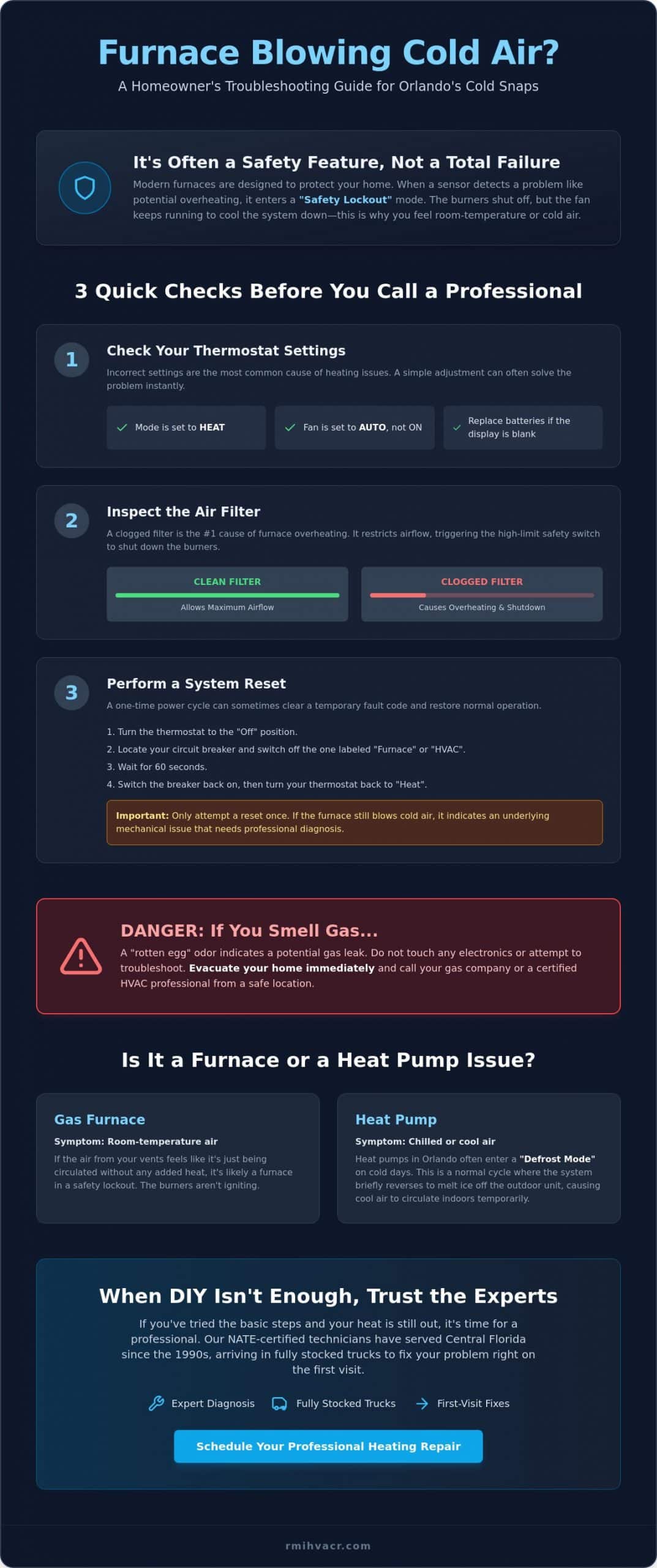
A furnace lockout is a protective shutdown triggered by internal sensors to prevent hazardous conditions like overheating or gas accumulation. This is a common occurrence in modern systems designed with advanced safety protocols. If your vents are emitting air that feels “chilled” rather than just room temperature, you might actually be dealing with a heat pump in defrost mode. However, if the air is consistently room temperature, the system is likely just moving air through the house without the benefit of a flame.
The Role of the Blower Fan
The blower fan is the workhorse of your HVAC system. Its primary job is to circulate air through your home. If your thermostat is set to “On” rather than “Auto,” the fan will run 24/7, even when the heating cycle isn’t active. This results in the sensation of a furnace blowing cold air because the air isn’t being heated before it hits your skin. Additionally, if the system detects an error, the fan often continues to run to cool down the heat exchanger. This is a deliberate design choice to prevent the metal from warping or cracking due to excessive heat. Our team has seen this frequently since we began serving Orlando in the 1990s. It’s a sign the system is trying to protect itself.
Signs of a System Lockout
Modern furnaces are equipped with diagnostic tools to tell you what’s wrong. If you look through the small sight glass on your furnace cabinet, you’ll likely see a blinking LED light. These flashes are error codes. A specific pattern might indicate a “Safety Lockout.” This happens after the furnace tries and fails to ignite several times. While you can sometimes reset the system by cycling the power, doing this repeatedly is dangerous. It masks the underlying problem, such as a clogged filter or a faulty sensor. If you suspect a mechanical failure, professional furnace repair is the safest course of action. Ignoring these signals can lead to more expensive repairs or even safety hazards like cracked heat exchangers.
3 Quick Troubleshooting Steps Before Calling a Professional
Before you assume the worst about your heating system, take a deep breath. A furnace blowing cold air can often be resolved with a few simple adjustments that don’t require a toolbox. These checks are designed to rule out common “user error” issues, potentially saving you the cost of a service fee. However, safety is our absolute priority. If you smell gas or a “rotten egg” odor at any point, do not attempt to troubleshoot. Exit your home immediately and contact an expert.
Our team has provided dependable service to Orlando homeowners since 1999. We know that a cold house during a Florida winter feels like a true emergency. By following this logical sequence, you can determine if your system needs a professional touch or just a quick reset.
Step 1: Check the Thermostat Settings
It sounds simple, but the thermostat is the most frequent culprit. Ensure the system switch is set to “Heat.” If the screen is blank or flashing a low battery icon, replace the batteries immediately. Even if the display seems fine, weak batteries can prevent the thermostat from sending a signal to the furnace. Another common issue is the fan setting. If the fan is set to “On,” it will blow air continuously, even when the furnace isn’t heating. Change this setting to “Auto” so the blower only runs during a heating cycle.
Step 2: Inspect and Replace the Air Filter
A clogged filter is the primary cause of airflow restriction. When air can’t move through the system, the heat exchanger becomes too hot. This triggers the high-limit switch to shut off the burners while the fan keeps running to cool the unit down. This results in your furnace blowing cold air as a safety precaution. Check your filter for a thick layer of gray dust or debris. For Orlando homes, we generally recommend a MERV 8 to MERV 11 filter to balance air quality with proper airflow. Following basic furnace maintenance tips like monthly filter checks can prevent these annoying shutdowns.
Step 3: Verify Power and Gas Supply
Check your electrical panel for a tripped circuit breaker. Additionally, look for a switch near the furnace that looks exactly like a standard light switch. This is the power disconnect, and it can be accidentally flipped off by someone moving boxes or cleaning. Finally, ensure the gas valve on the supply line is in the “Open” position, parallel to the pipe. If you have an older model with a standing pilot light, you can check if it has gone out. If these steps don’t restore your warmth, it’s time to stop the DIY efforts and call for a professional furnace repair to identify deeper mechanical failures.
If you’ve completed these steps and your home is still chilly, our technicians are ready to help. We arrive in fully stocked trucks to ensure we can solve your problem quickly and get your family back to a comfortable temperature.
Common Mechanical Failures That Require Expert HVAC Repair
When your furnace blowing cold air isn’t solved by a thermostat check or a filter change, the problem usually lies within the complex internal components. These parts require specialized diagnostic tools and professional training to handle safely. Attempting to repair gas valves or electrical ignition systems yourself can lead to dangerous gas leaks or fire hazards. RMI Heating and Air Conditioning has been the dependable choice for Orlando homeowners since 1999, providing the stability and expertise needed to handle these high-stakes repairs correctly the first time.
While homeowners can take minor steps to improve your heating system, mechanical repairs require professional certification. For these technical issues, it is essential to contact professional furnace repair services. Our technicians arrive in fully stocked trucks, prepared to address these intricate failures during the initial visit to restore your home’s comfort quickly.
Dirty or Faulty Flame Sensors
If your heater ignites for exactly five seconds and then shuts down, you are likely dealing with a dirty flame sensor. This small, thin rod sits in the path of the burner flame. Over time, carbon buildup or oxidation creates a thin layer of insulation on the sensor. This prevents the system from “seeing” the flame. Because the furnace thinks the gas is flowing without a fire, it shuts down immediately to prevent unburned gas from accumulating in your home. Cleaning these sensors requires precision. If the porcelain housing is cracked or the sensor is too worn, a full replacement is the only reliable solution.
Cracked Heat Exchangers and Ductwork Leaks
A cracked heat exchanger is the most serious mechanical failure a furnace can experience. This component separates the combustion gasses from the air circulating in your home. If it cracks, carbon monoxide can leak into your living space, creating a life-threatening situation. This often happens when a furnace blowing cold air is ignored for too long, causing the metal to stress and fracture.
In other cases, the furnace might be working perfectly, but massive duct leaks in your attic are the culprit. In Central Florida, attic temperatures can drop significantly during a cold snap. If your return ducts have holes, they can pull in 50-degree attic air, which overwhelms the furnace’s ability to heat. Our experts use static pressure testing to diagnose these airflow issues, ensuring we provide an honest diagnosis rather than recommending unnecessary equipment replacements.
Is It a Furnace or a Heat Pump? Solving Cold Air Issues in Central Florida
In Central Florida, many homeowners use the term “furnace” as a generic label for their heating system. However, the majority of Orlando homes actually utilize electric heat pumps rather than gas-fired furnaces. While a traditional gas furnace burns fuel to create intense heat, a heat pump simply moves heat from the outside air into your living space. This distinction is vital when you are troubleshooting a furnace blowing cold air. Heat pumps have specific operational modes that can mimic a system failure even when they are functioning exactly as designed.
Since we began serving the community in 1999, we’ve found that understanding your specific equipment is the first step toward a stress-free winter. Heat pumps are highly efficient, but they operate under different physical principles than combustion heaters. If your system feels like it is failing, it may just be reacting to the unique demands of a Florida cold snap.
The Defrost Cycle Explained
When outdoor temperatures drop and humidity is high, moisture can freeze on the outdoor unit’s coils. To clear this ice, your system enters a “Defrost Mode.” During this cycle, the heat pump temporarily reverses its operation. It essentially runs in air conditioning mode to send heat to the outdoor coils to melt the frost. This process often results in a 10-minute blast of chilly air through your vents. If you notice this happening occasionally, it is likely a normal part of the system’s operation. However, if the cold air persists or the outdoor unit remains encased in ice, you likely need professional heating system repair to inspect the defrost board or the reversing valve.
Auxiliary and Emergency Heat Issues
Heat pumps lose their heating capacity as the outdoor temperature approaches freezing. To compensate, most systems are equipped with auxiliary electric heat strips. These strips provide the extra boost needed to maintain your thermostat setting. If these strips fail to activate due to a faulty sequencer or a tripped breaker, you will experience a furnace blowing cold air because the outdoor unit alone cannot keep up. It is also helpful to manage expectations regarding temperature. A heat pump typically produces air between 100 and 110 degrees. While this is warm enough to heat your home, it feels much cooler than the 140-degree air produced by a gas furnace, leading some homeowners to believe the system is broken when it is simply performing at its standard capacity.
Our team remains committed to providing the honest diagnosis you deserve. We arrive in fully stocked trucks to ensure that whether you have a failing heat strip or a technical control issue, we can get the job done right the first time. Schedule your heat pump diagnostic today to ensure your home stays warm regardless of the temperature outside.
Professional Heating Solutions: Why RMI Heating and Air Conditioning is Orlando’s Top Choice
When you experience a furnace blowing cold air, you need more than just a quick fix. You need a partner who understands the nuances of Central Florida’s unique climate and the technical demands of modern HVAC systems. RMI Heating and Air Conditioning has been that partner for Orlando homeowners since 1999. Our longevity in the industry is a testament to our commitment to excellence and honest service. We don’t just guess at the problem. Our NATE-certified technicians use precise diagnostics to identify exactly why your system has failed. This high level of professional certification ensures that your heating system is handled with the technical expertise it deserves.
We respect your time and your home. That’s why we maintain a “Fully Stocked Truck” promise for every service call. Our teams arrive prepared with the inventory and specialized equipment needed to resolve most issues on the first visit. This efficiency minimizes your discomfort and gets your home back to its ideal temperature without unnecessary delays. Whether you’re dealing with a failing ignition or a complex control board failure, our goal is to restore your warmth immediately. Our serious, no-nonsense approach to service has made us a staple of stability in the Central Florida community for decades.
24/7 Emergency Service When You Need It Most
Florida winters are usually mild, but when a freeze hits, it hits hard. A furnace blowing cold air at midnight is a genuine emergency for families and seniors. Our teams are available around the clock to provide rapid response when you need it most. We’re prepared to service gas, oil, and electric heating systems with the same level of calm competence. You shouldn’t have to wait days for warmth or worry about the safety of your home. Our technicians are trained to handle potential hazards with professional care. Schedule your emergency heating repair now to secure your home’s comfort and safety.
The Benefits of Professional Maintenance
The most effective way to handle a heating crisis is to prevent it from ever happening. Regular professional care is the key to long-term reliability. A comprehensive maintenance tune-up prevents common failures like the dirty flame sensors or clogged filters discussed in previous sections. These inspections allow us to catch small mechanical issues before they turn into expensive, mid-winter breakdowns. Maintenance also extends the lifespan of your equipment by protecting it against the harsh Florida humidity that can corrode sensitive components. Our safety inspections cover every heating component, giving you the peace of mind that your system is safe for your family to use all season long.
Restore Your Home’s Comfort Today
Dealing with a furnace blowing cold air is a stressful experience, but you now have the knowledge to identify the root cause. You’ve learned that simple troubleshooting like checking thermostat settings or filters can solve minor issues, while technical failures like faulty flame sensors or heat pump defrost cycles require a professional touch. Prioritizing safety and efficiency ensures your system performs reliably when the temperatures drop.
Get Your Heat Back On—Schedule Expert Furnace Repair with RMI Heating and Air Conditioning Today
You don’t have to wait out the cold alone. Our team is ready to provide the fast, professional results you need to stay warm and comfortable all season long.
Frequently Asked Questions
Why is my furnace blowing cold air after I changed the filter?
It’s likely that your system is stuck in a safety lockout from the previous overheating event. When the old, clogged filter restricted airflow, the high-limit switch tripped to protect the heat exchanger from damage. This restriction often manifests through sound as well; Christensen Heating and Cooling notes that a whistling noise is a key indicator of the air pressure issues that lead to such lockouts. Even with a clean filter installed, you may need to power cycle the unit to clear the error code. This allows the burners to ignite and resume a normal heating cycle.
Can a thermostat cause a furnace to blow cold air?
Yes, incorrect thermostat settings or low batteries are common causes of a furnace blowing cold air. If the fan is set to “On” instead of “Auto,” the blower runs continuously even when the heating cycle is off. Additionally, a faulty thermostat might fail to signal the burners to ignite while still triggering the distribution fan. Checking these settings first can often save you a service call.
How do I reset my furnace after it blows cold air?
You can usually reset the system by turning the power switch or circuit breaker off for 30 seconds before turning it back on. This action clears the control board’s temporary memory and resets the safety sensors. If the system fails to stay lit after this reset, it indicates a persistent mechanical issue. Repeatedly resetting a failing furnace can cause long-term damage to the internal components and should be avoided.
Is it dangerous if my furnace is blowing cold air?
While the air itself isn’t dangerous, the underlying cause might be a safety concern like a cracked heat exchanger. Modern systems often blow cold air as a protective measure to cool down a potentially overheating unit. If you smell gas or notice a persistent safety lockout pattern, you should shut down the system immediately. Our experts can provide a safety inspection to ensure your home remains secure.
How long should it take for my furnace to blow warm air?
Most gas furnaces take between 30 seconds and two minutes to begin blowing warm air after the thermostat calls for heat. This delay allows the burners to ignite and the heat exchanger to reach the proper temperature before the blower fan starts. If the air remains cold after three minutes, your system has likely failed to complete its ignition sequence and requires professional attention to restore warmth.
Why does my heat pump blow cold air in the winter?
Your heat pump may be in its automatic defrost cycle, which temporarily moves heat outside to melt ice on the coils. This process typically lasts about 10 minutes and can result in a furnace blowing cold air through your vents. If the cold air continues longer than 15 minutes, your auxiliary heat strips or reversing valve may need professional repair. This is a common occurrence during humid Orlando winter nights.
What does it mean if my furnace starts then immediately blows cold air?
This symptom usually points to a dirty or faulty flame sensor that can’t detect a successful ignition. The system starts the burners, but because the sensor fails to “see” the flame, it shuts the gas off immediately for safety. The fan then continues to run to purge any unburned gas from the cabinet. This safety feature makes it feel like the unit is only blowing cold air despite the initial start.