
AC Refrigerant Leak Repair Cost: 2026 Price Factors and Florida Homeowner Guide

Imagine waking up at 2:00 AM to a sweltering Orlando house because your air conditioner stopped working in the middle of a humid Florida night. If you’ve noticed a hissing sound or a sudden spike in your utility bills, you’re likely facing a leak. Understanding the ac refrigerant leak repair cost is the first step toward restoring your home’s comfort. It’s frustrating to deal with technical jargon like R-410A phase-outs and EPA thresholds when you just want a cool bedroom and a fair price.
We understand that an unexpected AC breakdown feels like a crisis. This guide clears the confusion. You’ll discover the real factors behind these expenses and learn whether a professional repair or a full system replacement is your most cost-effective move. We’ll preview the impact of 2026 regulatory changes, explain why “topping off” a structural leak is a costly mistake, and provide a clear decision framework to help you protect your investment and your family’s comfort. Our goal is to provide the professional, prompt, and prepared service you need to stay cool.
Key Takeaways
- Learn why Florida’s unique humidity and salt air accelerate system breaches and how to identify a leak in your AC’s closed-loop system.
- Understand the multi-phase process of diagnostic testing and component replacement that determines your total ac refrigerant leak repair cost.
- Apply the “5,000 Rule” to calculate whether repairing your current unit or investing in a new, energy-efficient system is the better financial move.
- Discover why simply “topping off” refrigerant is a temporary fix that can lead to permanent compressor damage and higher utility bills.
- See how professional expertise and fully stocked service vehicles ensure your cooling system is restored efficiently and correctly the first time.
Understanding AC Refrigerant Leaks and Repair Costs in Florida
A refrigerant leak is a structural failure within your air conditioning system. Many homeowners mistakenly believe that refrigerant is a consumable fluid, much like gasoline in a car, that requires periodic “topping off.” This is a myth. Your air conditioner is a closed-loop system designed to retain its charge for its entire lifespan. If the level is low, there is a physical hole or breach in the copper lines or coils. To understand what a refrigerant is, imagine a specialized chemical that shifts between liquid and gas to move heat out of your home. It should never escape.
In Central Florida, the environment is particularly aggressive toward HVAC equipment. High humidity and airborne contaminants create a perfect storm for system failures. As we move through 2026, the ac refrigerant leak repair cost is heavily influenced by new EPA regulations. These rules, which became effective January 1, 2026, have lowered leak repair thresholds and restricted the installation of new R-410A systems. This regulatory shift means that managing a leak is no longer just about comfort; it’s about compliance and long-term financial planning.
Common Signs Your AC Has a Leak
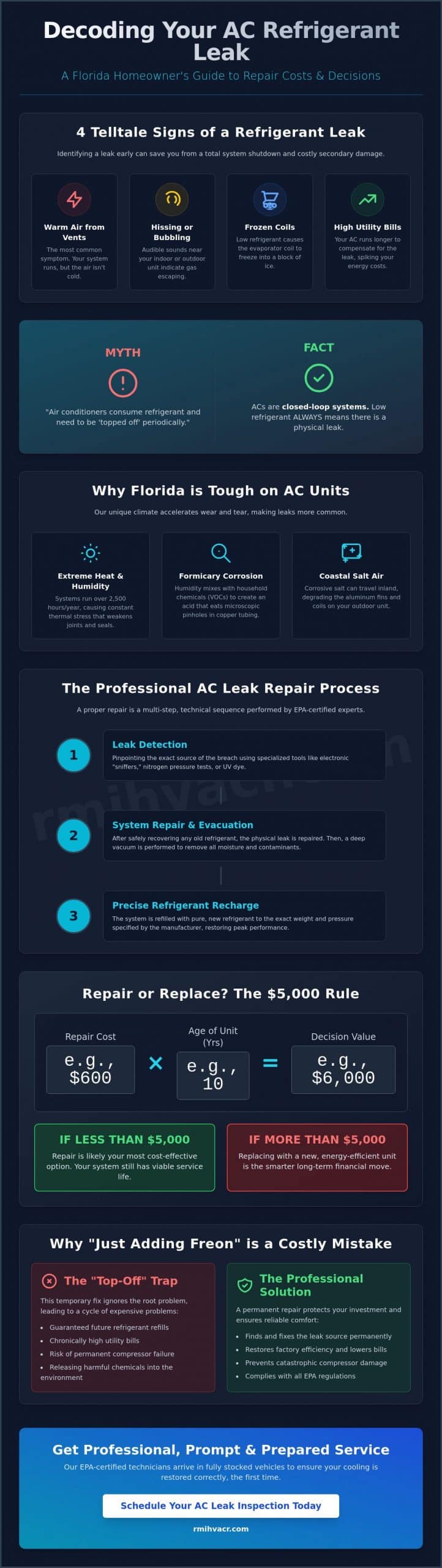
Identifying a leak early can prevent a total system shutdown. If you notice any of the following, your system likely has a breach:
- Warm Air: The vents blow room-temperature air even when the compressor is running.
- Strange Noises: Hissing or bubbling sounds near the indoor air handler or outdoor unit indicate gas escaping under pressure.
- Frozen Coils: A lack of refrigerant causes the evaporator coil temperature to drop below freezing, turning condensation into a block of ice.
- High Bills: A leaking system runs longer to meet the thermostat’s demands, causing a spike in your Orlando utility costs.
Why Florida Systems Are Prone to Leaks
Florida homeowners deal with specific environmental stressors that accelerate wear. Our systems often run for more than 2,500 hours annually, leading to significant thermal stress. In cities like Sanford and Kissimmee, the combination of heat and humidity causes metal components to expand and contract constantly. This movement eventually weakens solder joints and seals.
Formicary corrosion is another major culprit. This occurs when high humidity interacts with household VOCs to create a mild acid that eats pinholes into copper tubing. These leaks are often microscopic and difficult to detect without specialized equipment. Additionally, coastal salt air can migrate inland, corroding the aluminum fins on outdoor units. If you suspect these environmental factors have compromised your unit, seeking professional air conditioning repair is the most reliable way to protect your investment and restore your home’s comfort.
Breaking Down the Cost Factors: Detection, Repair, and Recharge
Calculating the ac refrigerant leak repair cost involves more than just a simple fix. The process is a technical sequence that requires specialized equipment and EPA-certified expertise. Every repair begins with recovery. Technicians must safely remove any remaining gas before they can open the system to the atmosphere. This is a critical step for both safety and compliance with federal leak repair requirements. Once the system is sealed, we perform a deep vacuum to remove moisture and non-condensables. This ensures the new refrigerant remains pure and the compressor stays protected from internal acid damage.
The Cost of Leak Detection Methods
Finding a microscopic hole in hundreds of feet of copper tubing requires precision. Electronic “sniffers” are often the first line of defense. These tools detect the chemical signature of escaping gas. While fast, they can sometimes struggle with very small micro-leaks in windy outdoor environments. For stubborn breaches, a nitrogen pressure test is the gold standard. We pressurize the system with dry nitrogen and monitor the gauges for any drop. This method is highly reliable for confirming the system is airtight before adding expensive refrigerant. Ultraviolet (UV) dye is another option for systems with multiple suspected leak points, though it requires a follow-up visit to inspect the components with a specialized light.
Refrigerant Prices in 2026
The 2026 landscape has changed how we view recharge costs. Because the production of R-410A has been reduced significantly, the price for this older refrigerant has seen a steady increase of 40% to 60% since the phase-down began in 2025. This makes a large leak in an older system a major financial consideration. Newer systems manufactured after 2025 use A2L refrigerants like R-454B or R-32. These chemicals have a much lower Global Warming Potential. However, they are classified as slightly flammable, which means they require specific handling procedures and specialized tools. The total bill is ultimately driven by your unit’s capacity; a five-ton residential system requires much more material than a smaller two-ton unit.
Labor and Component Replacement
Labor costs often depend on the accessibility of your equipment. In many Florida homes, indoor air handlers are tucked into tight closets or attic spaces. This increases the time required to perform a coil swap or solder a line set. Patching a simple copper line is generally less intensive than replacing an entire evaporator or condenser coil. A professional “evacuate and recharge” process typically takes several hours to complete correctly. If your system is struggling to keep up with the heat, scheduling a professional air conditioning maintenance check can help identify these issues before they become expensive emergencies. Our technicians arrive in fully stocked vehicles, ready to provide the efficient service your home deserves.
The Repair vs. Replace Dilemma: When a Leak Means a New Unit
Deciding whether to fix a leak or buy a new unit is one of the toughest choices a homeowner faces. While the initial AC refrigerant leak repair cost might seem manageable, you have to look at the long-term health of your system. Central Florida’s climate is unforgiving. A system that has been leaking for months often suffers from more than just low gas. When refrigerant levels drop, the compressor, which acts as the heart of your AC, overheats and works twice as hard. This strain can lead to premature failure, turning a simple leak into a total system collapse.
The “5,000 Rule” provides a helpful financial framework for this decision. Multiply the age of your unit by the estimated repair quote. If the total exceeds $5,000, professional consensus usually points toward replacement. For instance, a 10-year-old unit requiring a $600 repair equals $6,000. In this scenario, investing that money into a modern, SEER2-compliant system is often the more dependable move. These newer units offer significantly better efficiency and lower Global Warming Potential, which reduces your monthly overhead in the long run.
When Repair Makes Financial Sense
Repairing your unit is often the right call for systems that are still in their prime. If your AC is under 5 or 7 years old, it likely still has a valid manufacturer’s parts warranty. This can significantly lower your ac refrigerant leak repair cost because you may only be responsible for labor and the refrigerant itself. Repairs are also advisable when the leak is found in an easy-to-reach area, such as the service valves or a simple joint. A history of regular maintenance also plays a role. A well-maintained system is more likely to survive a single component failure without cascading issues.
When Replacement Is the Smarter Investment
Replacement becomes the logical choice when your system relies on obsolete refrigerants like R-22 or even R-410A as it nears the end of its lifespan. If a technician finds multiple leaks or pitting corrosion in the evaporator coil, a patch is just a temporary bandage. These micro-leaks often reappear elsewhere within months. Choosing a new air conditioning installation allows you to take advantage of modern energy rebates and the latest A2L refrigerant technology. This shift ensures your home stays cool with a reliable, warrantied system that won’t leave you stranded during a Florida heatwave.
Why “Just Adding Freon” Is a Costly Mistake
Choosing to simply add more gas to a leaking unit is a short-term gamble that rarely pays off. Leaks never fix themselves. While a quick refill might provide a few days of relief, it ignores the reality that your system has a physical breach. This approach doesn’t just waste money; it risks your entire HVAC investment. In Florida’s demanding climate, a small hole won’t stay small for long. Pressure and thermal expansion ensure that the ac refrigerant leak repair cost you face today will only increase if you delay the necessary fix.
Beyond the mechanical risks, there are strict legal considerations to keep in mind. EPA Section 608 regulations mandate specific repair actions for systems containing 15 pounds or more of high-GWP refrigerant. As of January 1, 2026, these thresholds are tighter than ever. Intentionally allowing a known leak to continue while repeatedly refilling it is environmentally irresponsible and technically against federal standards for larger units. Refrigerant leaks contribute significantly to global warming; making a permanent seal is the only ethical and legal choice.
When refrigerant escapes, moisture and air often find their way inside the copper lines. This is where the real damage begins. Moisture reacts with the chemical components of the refrigerant to create a highly corrosive acid. This acid circulates through your system, eating away at the copper windings of your compressor from the inside out. By the time you realize there’s a problem, the internal damage may already be irreversible.
The Hidden Damage of Low Refrigerant
Low levels prevent proper oil return to the compressor. Without this lubrication, internal friction increases and temperatures soar. Your system will also begin short cycling, which is when the unit turns on and off rapidly to try and meet the cooling demand. This behavior puts immense stress on electrical components and capacitors. A neglected $500 leak can easily transform into a $3,000 compressor failure within just a few months of operation.
The “Top-Off” Math: A Losing Game
If you compare the price of three emergency recharges against one permanent repair, the math is clear. With R-410A prices rising by 40% to 60% due to the current phase-down, refilling a leaking unit is a losing financial strategy. You also have to consider the frustration of emergency calls during the hottest Orlando weekends when technicians are in highest demand. For a permanent solution that protects your home and your wallet, scheduling a professional air conditioning repair is the only dependable path forward.
Professional AC Leak Solutions with RMI Heating and Air Conditioning
RMI Heating and Air Conditioning has served as a pillar of reliability for the Orlando community since 1999. We understand that managing an ac refrigerant leak repair cost involves more than just a financial transaction; it’s about restoring the safety and comfort of your home. Our “Fixed Right the First Time” philosophy ensures that our technicians don’t just treat the symptoms of a cooling failure. We identify the root cause of the breach to prevent recurring issues. Our NATE-certified professionals possess deep expertise in Florida’s unique environmental challenges. We understand how local humidity and salt air impact equipment. Whether you need residential support or complex commercial HVAC solutions, our team delivers results you can depend on.
Preparedness is a core marker of our service. Every RMI Heating and Air Conditioning service vehicle operates as a mobile warehouse. We arrive fully equipped with advanced electronic leak detectors, nitrogen pressure kits, and high-grade replacement components. This commitment to readiness allows us to respect your time and resolve most refrigerant issues during the initial visit. Our long-standing history in Central Florida serves as a testament to our stability. We are a serious, no-nonsense provider that prioritizes getting the job done correctly. You can trust our experience to navigate the complexities of 2026 refrigerant regulations and equipment standards.
What to Expect During an RMI Service Call
Transparency and communication are the foundations of our process. When our technician arrives, you’ll receive a detailed diagnostic report that outlines the exact location and severity of the leak. We don’t just focus on the immediate hole. We perform a comprehensive health check of your entire system, including electrical components and airflow efficiency. This holistic approach ensures your unit operates at peak performance after the repair. Because we know that a cooling failure in Florida is often a crisis, we maintain 24/7 availability. You’ll never be left stranded in a sweltering house during a midnight emergency.
Protecting Your Comfort and Your Budget
We believe that expert HVAC service should be accessible to every homeowner. If a diagnostic reveals that a leak is too extensive for a cost-effective fix, we provide clear options for air conditioning replacement. We offer financing options to help manage the investment in a new, high-efficiency system. Our team utilizes only the highest quality sealants and OEM components to ensure your repair lasts for years, not weeks. We don’t believe in temporary “top-offs” that lead to higher utility bills and permanent mechanical damage. Contact RMI Heating and Air Conditioning today to restore your home’s efficiency with a partner who values your long-term comfort.
Restore Your Home’s Cooling and Efficiency Today
Managing your ac refrigerant leak repair cost effectively requires a balance between immediate technical fixes and long-term financial planning. We’ve explored how the 2026 regulations and the R-410A phase-out are shifting the landscape for Florida homeowners. A refrigerant leak is always a structural failure, not a routine refill. Ignoring a breach only invites corrosive moisture into your system, leading to expensive compressor damage. Whether you use the 5,000 Rule or evaluate your warranty status, making an informed decision today protects your comfort and your wallet tomorrow.
RMI Heating and Air Conditioning has been a dependable partner for Central Florida families since 1999. We are A+ rated for our reliability and professionalism, providing the expertise needed to navigate complex HVAC transitions. Our team is ready with 24/7 emergency service to ensure you never have to suffer through a sweltering Orlando night. Don’t let a small leak turn into a total system failure. Schedule Your Expert AC Leak Diagnostic with RMI and restore your peace of mind. We look forward to helping you stay cool and efficient all year long.
Frequently Asked Questions
How long does an AC refrigerant leak repair take?
A professional repair typically takes between three and six hours to complete correctly. This timeframe includes the time needed to recover the remaining gas, find the breach with a nitrogen pressure test, and perform the physical repair. Technicians must also pull a deep vacuum to remove moisture before recharging the system with new refrigerant. Complex leaks in tight Florida attics or closets may require more time for component access.
Is it worth fixing a leak in a 10-year-old AC unit?
It is generally more cost-effective to replace a decade-old system rather than paying the ac refrigerant leak repair cost. Applying the 5,000 Rule, a 10-year-old unit requiring a major repair often exceeds the financial threshold for a sound investment. Since older units use R-410A, which is currently experiencing significant price increases, investing that money into a new SEER2-compliant system provides better long-term reliability and lower utility bills.
Can I find an AC leak myself with soapy water?
You can sometimes spot large leaks at visible joints using soapy water, but most breaches are microscopic and hidden. Professional technicians use specialized electronic sniffers and ultraviolet dyes to locate pinhole leaks caused by formicary corrosion. DIY methods often miss these tiny holes, which allows the system to continue losing gas. This leads to secret damage like compressor overheating and internal acid formation that eventually destroys the unit.
Does homeowners insurance cover AC refrigerant leaks?
Standard homeowners insurance policies rarely cover refrigerant leaks because they are classified as maintenance issues. Insurance is designed to handle sudden and accidental damage, such as fire, lightning, or hurricane impact. Since most leaks result from gradual wear, tear, or corrosion, the owner is responsible for the repair. It’s always a good idea to check your specific policy for any optional equipment breakdown endorsements you might have added.
What happens if I don’t fix a small refrigerant leak?
A small leak will always grow larger and eventually cause a total system failure. When refrigerant levels are low, the compressor lacks the oil return it needs for lubrication, leading to extreme heat and friction. The system will also short cycle, which burns out capacitors and other sensitive electrical parts. What starts as a minor cooling issue can transform into a three thousand dollar compressor failure within just a few months.
Is the refrigerant used in 2026 safer than older types?
The refrigerants used in 2026 are much safer for the environment due to their lower Global Warming Potential (GWP). New A2L refrigerants like R-454B have a GWP of approximately 466, which is a massive improvement over R-410A’s GWP of 2,088. While these newer gases are classified as slightly flammable, they are safe for home use when handled by certified professionals. They represent the industry’s commitment to more sustainable cooling technology.
Why is R-410A so expensive right now?
R-410A prices are rising because the EPA has strictly limited its production as part of a national phase-down. Since January 2025, manufacturers have faced significant cuts in production quotas, which has driven market prices up by 40% to 60%. As the supply continues to shrink and the industry moves toward newer A2L refrigerants, the cost to recharge older R-410A systems will likely continue to climb each year.
How often should I have my AC checked for leaks?
You should have your air conditioner checked for leaks at least once a year during a professional maintenance visit. Technicians can monitor pressure levels and inspect coils for early signs of corrosion before a major breach occurs. This proactive approach helps you avoid the high ac refrigerant leak repair cost associated with emergency breakdowns during a heatwave. Regular checks are the best way to ensure your system remains efficient and dependable.