
What if your skyrocketing utility bill isn’t just a result of the Florida heat, but a mechanical cry for help from your air conditioner? You aren’t alone in asking why is my electric bill so high in summer, especially when the average Florida household already pays between $165 and $175 per month for power. While Duke Energy implemented its third rate reduction of the year in June 2026, many homeowners still struggle with high usage that far exceeds the national average. It’s frustrating to listen to your AC run all day without ever reaching the temperature you set on the thermostat.
You deserve a home that’s both cool and cost-effective. We understand the anxiety that comes with unexpected utility spikes and the fear of needing an expensive system replacement. This guide will help you discover the mechanical and environmental reasons your Florida electric bill is spiking and how to restore efficiency to your home. We’ll examine current utility rates, the impact of the 15.2 SEER2 efficiency standards, and actionable steps you can take today to confirm your system is healthy and your monthly costs are under control.
Key Takeaways
- Identify common mechanical failures like dirty coils or low refrigerant that answer why is my electric bill so high in summer by reducing your system’s efficiency.
- Understand how Central Florida humidity forces your AC to work as a dehumidifier, increasing energy consumption before it even begins to cool your living space.
- Learn why upgrading from an older 10 SEER unit to a modern 15.2 SEER2 system can significantly lower your monthly power usage and utility costs.
- Discover actionable steps like ductwork inspections and thermostat adjustments that prevent you from wasting money cooling your attic instead of your home.
- Rely on a professional team with over 25 years of local experience to provide reliable, efficient repairs that restore your home’s comfort and your peace of mind.
Understanding the Florida Heat Tax: Why Summer Bills Spike
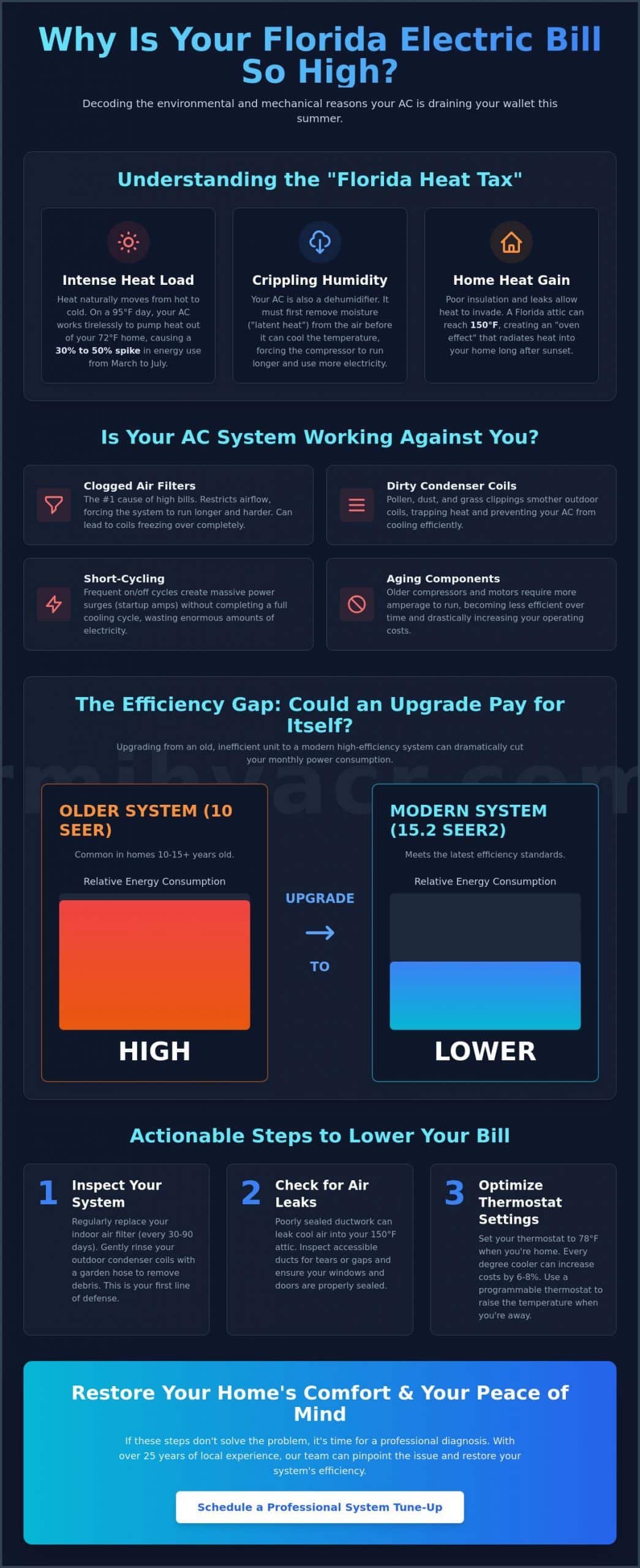
Living in Central Florida means accepting a certain “heat tax” during the peak of summer. It’s common to see your utility bill jump 30% to 50% between March and July. While this seasonal spike is expected, many homeowners find themselves wondering why is my electric bill so high in summer when their daily habits haven’t changed. The answer lies in the physics of our unique climate and how your home interacts with the environment.
The second law of thermodynamics states that heat always moves toward cold. On a 95 degree Orlando afternoon, the heat outside is constantly trying to force its way into your 72 degree living room. Your air conditioner has to work significantly harder to pump that heat back out as the temperature difference grows. This efficiency is often measured by the Seasonal Energy Efficiency Ratio (SEER), which determines how much cooling your system provides per watt of electricity used. When the heat outside climbs, even a high-performing system uses more energy to maintain the same indoor comfort level.
The heat index also plays a critical role. In Central Florida, a 92 degree day with high humidity can feel like 105 degrees. Your AC unit feels that difference too. It isn’t just fighting the raw temperature; it’s fighting the total energy load of the environment. Since 2006, our team has seen how these extreme conditions can push a neglected system to its breaking point.
The Role of Humidity in Energy Consumption
Florida’s humidity adds a hidden layer of work for your HVAC system. Professionals categorize this as “latent heat.” While “sensible heat” is the temperature you see on a thermometer, latent heat is the energy stored in the moisture in the air. Your AC must act as a dehumidifier before it can effectively lower the air temperature. If the air is damp, it feels warmer to your skin, which often leads you to lower the thermostat even further. Humidity removal requires your compressor to run longer and consume more kilowatt-hours (kWh) to condense water vapor out of the air before the actual cooling process can begin.
Heat Gain: Why Your Home Is Losing the Battle
Your home acts as a thermal envelope, but it isn’t a perfect seal. Central Florida homes often suffer from “heat gain” through poorly insulated windows and common construction leaks. On a typical summer day, a Florida attic can easily reach 150 degrees. This creates an “oven effect” that radiates heat downward through your ceiling and into your living space. This radiant heat continues to tax your AC long after the sun goes down. If your air conditioning maintenance is overdue, your system will struggle even more against these structural challenges. You’re essentially paying to cool your attic while your system runs around the clock to keep up.
Beyond AC maintenance, addressing the roof itself can be a game-changer for energy savings. Rainier Roofing LLC offers solar roofing systems that act as a high-tech shield, reducing the solar heat gain in your attic while generating power to offset your cooling costs.
Mechanical Culprits: When Your AC Is Working Against You
While the Florida sun is a powerful force, your air conditioner’s mechanical health determines how much that heat costs you. If you are asking why is my electric bill so high in summer, the answer often lies within the system’s internal components. An energy-efficient air conditioner is designed to move heat quickly. When mechanical issues arise, the system must run longer and work harder to achieve the same cooling effect, leading to a massive spike in energy consumption.
One common drain on your wallet is the “short-cycling” trap. This happens when your AC turns on and off too frequently. Starting a compressor requires a significant surge of electricity, often called “startup amps.” If your system cycles every ten minutes instead of running a full cooling cycle, you are paying for those power surges over and over again. Similarly, aging compressors in older units often require more amperage just to stay running, making them far less efficient than they were on day one.
Dirty Coils and Airflow Restrictions
In Central Florida, oak pollen, dust, and grass clippings act like a thick blanket on your outdoor condenser unit. This debris smothers the coils and prevents them from releasing heat into the outside air. Inside your home, a clogged air filter is the primary cause of preventable high bills. Restricted airflow prevents the evaporator coil from absorbing heat, which can lead to the coil freezing over entirely. When this happens, your system may continue to run while providing zero cooling, causing your meter to spin rapidly without any benefit to your comfort. If you notice reduced airflow, scheduling an air conditioning repair can often stop the financial drain before the system shuts down completely.
Refrigerant Leaks and System Pressure
There is a common myth that air conditioners “use up” refrigerant like a car uses gas. In reality, an AC is a closed system. It should never lose refrigerant unless there is a leak. Even a small pinhole leak causes the system pressure to drop, forcing the compressor to work at maximum capacity for hours. Running an undercharged system in 95 degree heat creates an exponential increase in your power bill because the unit never reaches the set temperature. You might hear a faint hissing sound or notice that your vents are blowing lukewarm air. These are clear signs that a leak is forcing you to pay for electricity that isn’t actually cooling your home. Our team focuses on finding these leaks rather than just “topping off” the system, ensuring a long-term solution for your utility costs.
The SEER2 Factor: Is Your Old Unit Costing You a Fortune?
If you have checked the mechanical health of your system and still wonder why is my electric bill so high in summer, the issue might be the unit’s baseline efficiency. In 2023, the Department of Energy updated efficiency standards to SEER2. This new testing method better reflects the high-pressure conditions of a Florida summer. While older Orlando homes often still run on 10 SEER units, the current legal minimum for new installations in Florida is 15.2 SEER2. This gap represents a massive amount of wasted electricity every single month.
The U.S. Energy Information Administration tracks average monthly electricity bills, noting how weather and regional rates impact what you pay. In Florida, where households use an average of 1,100 kWh per month, an inefficient unit can easily double your cooling costs compared to a modern system. At some point, you hit a tipping point where paying for repairs on a 15 year old unit no longer makes sense. The energy waste alone could eventually pay for the upgrade. Since the federal 25C tax credit expired at the end of 2025, homeowners should now focus on utility-specific rebates from providers like Duke Energy or FPL to offset costs.
Calculating Your Potential Savings
Upgrading from a 10 SEER unit to an 18 SEER2 system can cut your cooling costs by nearly half. It’s vital to get the sizing right during this process. An oversized unit will cycle too quickly and fail to remove humidity, while an undersized unit will run forever without cooling. Both scenarios drive your bill up. You can explore modern, properly sized options through our AC Replacement services to find a match for your home’s square footage.
Inverter Technology vs. Single-Stage Cooling
Modern high-efficiency systems often use inverter technology. Think of it like cruise control for your home. Traditional units are either 100% on or 100% off, which creates a huge startup surge on your electric meter every time they kick in. Inverter systems use variable-speed fans and compressors to adjust their output based on the actual cooling need. They run at lower speeds for longer periods, which is much more efficient. This constant, gentle airflow is also the best way to manage Central Florida’s heavy humidity, keeping you comfortable without the constant energy spikes. Our technicians specialize in these advanced systems to ensure you get the maximum ROI on your energy investment.
3 Actionable Steps to Lower Your Bill Immediately
You don’t have to accept a massive utility spike as an unavoidable reality. If you are tired of asking why is my electric bill so high in summer, these three steps provide a clear path to relief. While some efficiency issues require professional intervention, adjusting your habits and inspecting your home’s infrastructure can yield immediate results. Our goal is to help you find the perfect balance between a cool home and a manageable budget.
Thermostat Management and Smart Settings
The most effective way to control costs is through disciplined thermostat management. Industry experts and utility providers generally recommend a summer setting of 78 degrees when you are home. Every degree you lower the temperature below 78 can add roughly 5% to 8% to your monthly cooling costs. If you find this too warm, a smart thermostat can help by gradually lowering the temperature before you arrive home, preventing the system from working at maximum capacity to cool a heat-soaked house all at once.
Another critical setting is your fan. In Florida’s humid climate, you should keep your fan set to “Auto” rather than “On.” When the fan is set to “On,” it runs continuously even when the compressor is off. This can actually blow the moisture that was just collected on the evaporator coils back into your home, forcing the AC to run longer to dehumidify the air again. This simple switch can answer why is my electric bill so high in summer for many homeowners.
Duct Integrity and Insulation
Your ductwork is the delivery system for your comfort. If those ducts are leaky, you are essentially paying to cool your attic instead of your living room. Common signs of duct failure include excessive dust near vents or rooms that stay warmer than the rest of the house despite the AC running. Sealing these leaks is often the most overlooked energy-saving repair. Additionally, check your attic’s insulation and window efficiency. For those in the Panhandle, the Emerald Coast Window Authority helps homeowners find specialists to ensure their windows provide a proper thermal barrier. Without a solid barrier against the 150-degree attic heat and solar radiation, your AC is fighting a losing battle against the structural heat gain of your home.
Schedule a Professional Tune-Up
While DIY checks are helpful, a professional technician has the tools to identify hidden efficiency drains. During a comprehensive AC Maintenance & Tune-Up, we check electrical connections, clear condensate drain lines, and ensure your system’s refrigerant charge is precise. These technical adjustments often pay for themselves through lower monthly bills and the prevention of major mechanical failures. Regular service also preserves your manufacturer warranty, ensuring you stay protected for the long term.
Don’t wait for a total system shutdown during an August heatwave. Schedule your comprehensive AC Maintenance & Tune-Up today to lock in your home’s efficiency and restore your peace of mind.
Dependable Cooling Solutions with RMI Heating and Air Conditioning
RMI Heating and Air Conditioning has served the Central Florida community since 2006. We understand the specific environmental stressors that impact your HVAC system in our unique climate. If you are struggling with why is my electric bill so high in summer, it’s time to partner with a team that values your comfort and your budget. Our technicians bring over 25 years of local experience to every service call. We don’t rely on guesswork. We perform personalized efficiency audits to pinpoint exactly where your energy is escaping. Whether you live in Orlando, Kissimmee, or the surrounding suburbs, we are ready to help you restore your home’s efficiency.
We value your time and your peace of mind. Our “Fully Stocked Truck” promise means our technicians arrive prepared with the specialized equipment and inventory needed to solve most problems in a single visit. This level of preparedness reduces the need for follow-up appointments and helps you avoid multiple service fees. When a high utility bill is a symptom of a deeper mechanical failure, you need a partner who responds with urgency. We offer 24/7 emergency support to ensure your family remains safe and cool during extreme Florida heatwaves.
The RMI Difference: Professionalism and Preparedness
Our team maintains a deep focus on high-efficiency system expertise. We stay updated on the latest SEER2 regulations and inverter technology to provide the most effective solutions for your property. We bring the same level of professional certification and reliability to both residential homes and commercial facilities. If your system has already reached a breaking point due to the summer heat, you can access our Emergency AC Repair services for immediate assistance. We aim to take the stress out of technical problems through calm, competent delivery.
Plan for the Future with Maintenance Contracts
The most effective way to avoid “bill shock” in the future is through consistent, proactive care. Our HVAC Maintenance Contracts are designed to identify minor wear and tear before it forces your system to overwork. These plans provide a structured way to manage your home’s health and provide a definitive answer to why is my electric bill so high in summer by keeping your unit in peak condition. We are dedicated to your long-term well-being and satisfaction. Our long-standing history in the region is a testament to our stability and our commitment to getting the job done right the first time.
Take Control of Your Summer Utility Costs Today
Finding the answer to why is my electric bill so high in summer is the first step toward reclaiming your household budget. We have explored how Florida’s humidity, aging equipment, and outdated efficiency standards work together to drive up costs. By taking proactive steps like duct sealing and proper thermostat management, you can stop the financial drain and restore your home’s efficiency.
RMI Heating and Air Conditioning has provided reliable service to the Central Florida community since 2006. We prioritize professionalism and preparedness. Our fully stocked trucks allow our technicians to complete most repairs during the initial visit, which respects your time and your comfort. If a high bill turns into a system emergency, our 24/7 emergency service is always available to protect your family. Stop overpaying for cooling—schedule your RMI high-efficiency tune-up today!
You deserve a home that is both comfortable and cost-effective. Take these actionable steps today to restore your system’s health and enjoy the rest of the Florida summer with total peace of mind.
Frequently Asked Questions
Why is my electric bill so high all of a sudden?
Sudden spikes often stem from mechanical malfunctions or refrigerant leaks that force the compressor to run without stopping. In Central Florida, it might also relate to utility rate changes or the expiration of temporary cost recovery credits. If your habits haven’t changed but your usage has, your system likely has a failing component that requires professional attention to prevent a total breakdown.
Is it cheaper to leave the AC on all day or turn it off when I leave?
It is more efficient to raise the temperature by 7 to 10 degrees while you are away rather than turning the unit off. Turning the system off allows Florida’s high humidity to saturate your home’s fabrics and walls. When you return, the AC must run for hours just to remove that moisture before the temperature actually begins to drop, leading to higher energy consumption.
How much can a dirty air filter actually increase my bill?
A severely clogged filter can increase your energy usage by up to 15% by forcing the blower motor to work harder. This restriction in airflow is a primary reason why is my electric bill so high in summer for many local residents. Changing your filter every 30 days is the easiest way to prevent this unnecessary financial drain and protect your system’s motor.
What is the most efficient temperature to set my AC in Florida?
Setting your thermostat to 78°F provides the best balance between comfort and cost according to most utility experts. Lowering the setting further can increase your bill by 5% to 8% for every single degree. If 78°F feels too warm, try using ceiling fans to manage the “feel” of the air without overtaxing your cooling system’s compressor.
Does a ceiling fan actually help lower my electric bill?
Ceiling fans lower your bill by allowing you to raise the thermostat setting without sacrificing comfort. They create a breeze that helps moisture evaporate from your skin, making you feel significantly cooler. However, fans do not lower the actual room temperature. You must turn them off when you leave the room to avoid wasting electricity on an empty space.
How do I know if my AC unit is too old to be efficient?
If your system is over 10 years old, its efficiency has likely dropped significantly compared to modern SEER2 units. You can check the manufacture date on the outdoor condenser’s nameplate to confirm its age. Older units often require more amperage to start and run, which leads to a steady increase in your monthly power consumption as the internal components age.
Can leaky ductwork cause my electric bill to double?
Leaky ducts can cause your bill to skyrocket by dumping 20% to 30% of your cold air into unconditioned spaces like your attic. This effectively forces you to pay for cooling that never reaches your living area. Sealing these leaks is one of the most effective ways to lower your monthly energy costs and improve the overall airflow in your home.
What are the signs that my AC is working too hard?
An AC that runs for more than 30 minutes at a time or cycles on and off every few minutes is working too hard. You might also notice lukewarm air coming from the vents or ice forming on the refrigerant lines. These signs indicate that your system is struggling to keep up with the heat and is consuming excessive power in the process.