
Why Does My House Feel So Humid With the AC On? (2026 Central Florida Guide)

It’s a familiar story for countless Central Florida homeowners: the thermostat is set to a crisp 72 degrees, but you’re still dealing with that damp, clammy air that makes everything feel sticky. You know the system is running and blowing cold air, which makes it even more frustrating. If you’re constantly asking, why does my house feel so humid with the ac on, you’re not alone and the answer is often more complex than just the temperature setting.
You can count on this guide to solve that problem. We promise to uncover the technical reasons your home feels this way, from an oversized unit to a blocked drain line, without the confusing jargon. Our certified experts will provide the exact, actionable steps you need to take to restore crisp, dry comfort to your living space, lower your energy bills, and protect your home from the threat of mold growth. This guide will show you how to diagnose the issue and finally achieve that ideal 45-55% indoor humidity level you deserve.
Key Takeaways
- Understand how your air conditioner’s cooling process is also its primary way of removing humidity, and what can interrupt this critical function.
- Discover the most common reasons why your house feels so humid with the ac on, from incorrect fan settings to dirty internal components.
- Learn the “Oversized AC” paradox and why a unit that’s too powerful for your home often fails to properly dehumidify your living space.
- Find actionable troubleshooting steps you can take right now, like checking your air filter, to potentially solve the problem without a service call.
The Dual Mission: Why Your AC is Actually a Dehumidifier
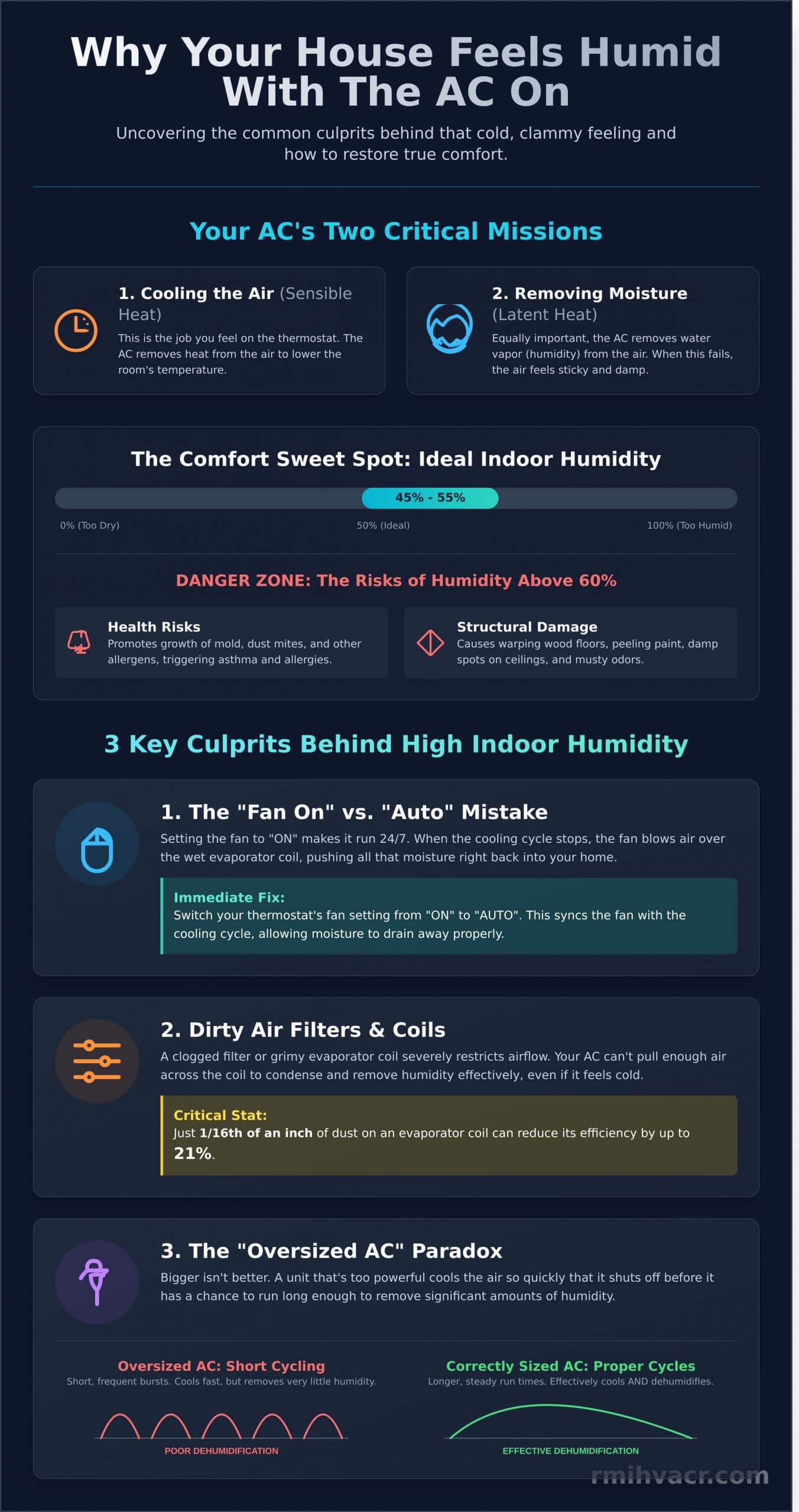
You’re not imagining it. That sticky, damp feeling in your home, even when the thermostat proudly displays a cool 72 degrees, is a real and common problem for Florida homeowners. The reason is simple: your air conditioner has two critical jobs, not just one. Its primary mission is to cool the air, but its equally important secondary mission is to remove moisture. When it fails at the second task, you’re left wondering, why does my house feel so humid with the ac on?
To understand this, we need to look at two types of heat. The first is Sensible Heat, which is the temperature you can feel and measure with a thermostat. The second, and more elusive, is Latent Heat. This is the energy held within the water vapor in the air. Your AC must fight both. An air conditioner removes sensible heat to lower the temperature, but it must also remove latent heat to reduce humidity. This is why a home at 72 degrees with humidity above 60% feels far more uncomfortable and warmer than the same temperature with humidity at a comfortable 50%.
How the Condensation Process Works
Your air conditioner performs its dehumidifying magic through a process of condensation, much like a glass of ice water “sweating” on a hot day. At the heart of this process is the indoor evaporator coil. This is a fundamental part of how air conditioning works. When your system runs, refrigerant makes this coil intensely cold. As warm, humid air from your home is pulled across it, the dramatic temperature drop forces the invisible water vapor in the air to turn back into liquid water. This condensation collects on the coil, drips into a drain pan, and is safely routed outside your home. The result is cooler, drier air being circulated back into your living space.
Defining “Ideal” Indoor Humidity for Florida Homes
For maximum comfort and health in Florida, the ideal indoor relative humidity level is between 45% and 55%. This “sweet spot” feels comfortable on your skin and protects both your family and your home. When humidity levels consistently rise above 60%, it creates an environment where problems can multiply quickly. Our expert technicians have seen firsthand the damage that uncontrolled humidity can cause.
- Health Risks: High humidity is a breeding ground for biological contaminants. Mold spores can begin to grow, dust mite populations explode, and other allergens thrive, potentially triggering asthma and allergy symptoms.
- Structural Risks: Excess moisture gets absorbed by porous materials in your home. This can lead to warping wood floors, peeling paint or wallpaper, damp spots on ceilings, and a persistent musty odor in carpets and upholstery.
Effectively managing both temperature and humidity is the key to true home comfort. If your system is only winning half the battle, it’s not delivering the reliable, efficient performance you deserve.
5 Common Culprits: Why Your House Feels Like a Sauna with the AC On
Your air conditioner’s job is twofold: cool the air and remove excess moisture. When it only does the first part, you’re left with a cold, clammy environment that feels uncomfortable and inefficient. If you’re constantly asking, “why does my house feel so humid with the ac on?”, the answer often lies within the system itself. An expert diagnosis is always best, but the problem frequently traces back to one of five common, and often fixable, issues.
Let’s break down the most frequent reasons your home feels sticky even when the AC is running.
The “Fan On” vs. “Fan Auto” Mistake
This is the simplest problem to check and solve. Your thermostat has a fan setting, typically with “On” and “Auto” options. Setting it to “On” means the fan runs continuously, 24/7. When the cooling cycle stops, the fan keeps blowing air over the wet evaporator coil. This re-evaporates all the moisture the AC just worked hard to remove and pushes it right back into your home. The “Auto” setting, however, syncs the fan with the cooling cycle. When cooling stops, the fan stops, allowing collected water to drip off the coils and exit through the condensate drain.
Immediate Fix: Walk over to your thermostat right now. If the fan is set to “On,” switch it to “Auto.” This single change solves the problem for a surprising number of homeowners.
The Impact of Dirty Air Filters and Coils
Your AC dehumidifies by passing warm, moist air over the frigid evaporator coil. This rapid temperature drop causes condensation, effectively “squeezing” water from the air. But if your air filter is clogged or the coil itself is caked in grime, airflow is severely restricted. The system can’t pull enough air across the coil to remove humidity efficiently. You might notice musty odors or that your AC runs for much longer cycles. According to the U.S. Department of Energy, just 1/16th of an inch of dust on an evaporator coil can reduce its efficiency by up to 21%.
Beyond restricted airflow, several other mechanical issues can sabotage your comfort:
- Leaky Ductwork: Your return ducts pull air from your home to be cooled. If these ducts have leaks and run through a humid attic or crawlspace, they will suck that heavy, moist air directly into your AC system. Your air conditioner is then fighting a losing battle, constantly trying to dehumidify a fresh supply of swampy air.
- Frozen Coils: An evaporator coil covered in ice is completely ineffective. Ice forms a barrier that prevents warm air from making contact with the coil’s surface. This can be caused by dirty filters restricting airflow or a low refrigerant charge. Your AC will run and run, but no actual cooling or dehumidification can happen.
- Clogged Condensate Line: The water pulled from your air needs a place to go. It drains out of your home through a condensate line. Over time, this line can become clogged with algae and debris. When it does, water backs up into the drain pan and can even re-enter your home’s air supply, increasing humidity. A blocked drain is a common issue our certified technicians can resolve during a scheduled AC tune-up, preventing both humidity problems and potential water damage.
The “Oversized Unit” Paradox: Why Bigger Isn’t Better
It seems logical: a bigger, more powerful air conditioner should cool your home better, right? In reality, when it comes to HVAC systems, an oversized unit is one of the most common reasons homeowners ask, “why does my house feel so humid with the ac on?” A system that is too large for your home’s square footage creates a frustrating and inefficient cooling experience through a process called “short-cycling.” It cools the air so quickly that it never gets a chance to perform its second, equally important job: dehumidification.
An air conditioner needs to run for a sustained period, typically 15-20 minutes per cycle, to effectively remove moisture from the air. An oversized unit might hit your thermostat’s target temperature in under 10 minutes, satisfying the call for cooling but leaving gallons of water vapor hanging in the air. This is a frequent issue in Central Florida, where some contractors mistakenly “over-spec” a system, believing more tonnage is the best way to fight our intense heat. This approach only leads to a cold, clammy indoor environment and higher energy bills.
What is Short-Cycling?
Short-cycling is exactly what it sounds like: your AC kicks on, blasts frigid air for 5-8 minutes, and then abruptly shuts off. During the first part of any cooling cycle, the system removes “sensible heat,” which is the heat you can measure with a thermometer. Only after running for about 10 minutes does the indoor evaporator coil become cold enough to start condensing and draining significant amounts of water vapor, or “latent heat.” A short-cycling unit rarely reaches this crucial stage, leaving your home feeling damp and uncomfortable, much like a chilly basement.
The Solution for Oversized Systems
If you already have an oversized system, you don’t necessarily need a full replacement. Our certified experts can often implement effective solutions to manage the excess humidity and improve your comfort. The key is to extend the system’s run time or to treat humidity as a separate issue.
- Variable-Speed Technology: Modern air conditioners with variable-speed blowers and compressors can run at a lower, more consistent power level. This allows them to run for much longer cycles, giving them the time needed to pull moisture from the air without over-cooling your home.
- Whole-Home Dehumidifiers: Installing a dedicated whole-home dehumidifier is the most reliable fix. This system integrates with your existing ductwork to manage humidity levels independently of your AC. A professional-grade unit can remove over 100 pints of water from your home’s air every 24 hours, guaranteeing a crisp, comfortable feel.
- A Proper Manual J Load Calculation: For any new installation, this is non-negotiable. A Manual J calculation is an industry-standard protocol established by the Air Conditioning Contractors of America (ACCA). It analyzes dozens of factors, including window efficiency, insulation levels, home orientation, and local climate data, to determine the precise cooling load your home requires. It is the only guaranteed method to ensure your new system is sized for peak performance and comfort.
Getting the size right from the start prevents the frustrating feeling of a humid house with the AC on. It’s about finding the perfect balance of power and efficiency, a balance our trusted technicians have delivered since 1999.
Practical Troubleshooting: What to Check Before Calling the Pros
Before you pick up the phone, a few simple checks can often solve the problem or provide valuable information for a technician. If you’re wondering why does my house feel so humid with the ac on, starting with these five steps can save you time and money. These are the most common culprits our certified experts encounter, and many can be addressed without a service call.
Your air conditioner is a complex system, but its basic functions are straightforward. A problem in one area can easily disrupt its ability to dehumidify your home. Here is a reliable checklist to work through:
- Check Your Air Filter: A dirty, clogged filter is the number one cause of reduced AC performance. It restricts airflow over the evaporator coils, preventing them from getting cold enough to condense water vapor effectively. Also, check the MERV rating. A filter with a MERV rating above 12 can be too restrictive for some residential systems, causing the same airflow problem as a clog.
- Inspect the Outdoor Condenser Unit: Walk outside and look at your condenser unit. Is it covered in grass clippings, leaves, or dirt? The coils and fins on this unit are designed to release heat outside. If they are blocked, the system cannot cool efficiently, which directly impacts its ability to remove humidity indoors. Ensure there’s at least 24 inches of clear space around the entire unit.
- Examine Windows and Doors: Check for failed seals or gaps around your windows and doors. Even a small opening can allow a significant amount of warm, moist air to infiltrate your home, forcing your AC to work overtime and struggle against a constant source of new humidity.
The 24-Hour Humidity Test
Your thermostat’s fan setting could be the hidden problem. If your fan is set to “On” instead of “Auto,” it runs constantly, even when the cooling cycle stops. This blows air over the wet evaporator coils, re-evaporating that collected moisture right back into your house. To test this, purchase an inexpensive digital hygrometer. Set your fan to “Auto,” note the humidity level, and check it again after 24 hours. A drop of 5% or more indicates the fan setting was the issue.
Visual Inspection of the Drain Line
Your AC removes gallons of water from the air each day, which exits through a PVC condensate drain line. Locate this pipe near your indoor air handler; it will have a U-shaped bend called a “P-trap.” If this line clogs with algae or sludge, water backs up. Look for standing water in the drain pan or signs of a “wet switch” (a safety device that shuts off your AC) activation. As a preventative measure, you can pour one cup of distilled white vinegar down the line every 90 days to clear out buildup.
If you’ve performed these checks and your home still feels muggy, or if you discover a significant clog in your drain line that a simple flush can’t fix, it points to a more complex issue. Don’t let a small problem turn into a major repair. Schedule a professional inspection with our certified technicians today for cooling you can count on.
Professional Solutions: How RMI Restores Your Comfort
Feeling that sticky, humid air inside your home even when the AC is running is more than just uncomfortable; it’s a sign that your system isn’t performing correctly. At RMI, we deliver “Cooling You Can Count On,” a promise that extends beyond just temperature to total home comfort, including proper humidity control. Since 1999, our NATE-certified technicians have specialized in diagnosing and solving the unique climate challenges of Central Florida. We understand the specific reasons why your house feels so humid with the ac on, and we have the expert solutions to fix it right the first time.
Your comfort shouldn’t have to wait. That’s why our service vehicles arrive fully stocked with the most common parts and tools needed to address humidity issues on the spot. This commitment to preparedness means our certified experts can often complete repairs in a single visit, restoring your home’s dry, cool feel without delay. We don’t just find the problem; we provide an immediate, reliable solution.
Precision Tune-Ups and Coil Cleaning
One of the most common culprits of indoor humidity is a neglected system. Our technicians perform deep cleaning services that restore your evaporator coil’s ability to “sweat” and pull moisture from the air. A dirty coil can reduce dehumidification performance by over 20%. We also precisely check refrigerant levels. If your system is low on refrigerant, the coils won’t get cold enough to condense water vapor, leaving your air feeling damp and clammy. Our comprehensive tune-ups are the core of our preventative strategy. Learn more about our maintenance plans and see how they protect your comfort year-round.
Advanced Air Quality and Dehumidification Upgrades
For persistent humidity, especially during Florida’s “shoulder seasons” in spring and fall, a system upgrade may be the most effective long-term solution. We can install a whole-home dehumidifier that works with your HVAC system to manage moisture levels independently. We also specialize in upgrading homeowners to modern variable-speed air conditioners. These advanced systems run longer at lower speeds, a process that can remove up to 50% more moisture than traditional single-stage units. Don’t keep wondering why your house feels so humid with the AC on. Get a definitive answer from the experts. Schedule your expert AC inspection with RMI today and let us restore the crisp, cool comfort you deserve.
Your Solution to a Cool, Dry Central Florida Home
Living in a sticky, humid home isn’t the comfort you pay for. You now know that an oversized AC unit, clogged evaporator coils, or even leaky ductwork can be the real culprits behind that clammy feeling. This knowledge is the first step to finally understanding why does my house feel so humid with the ac on. While some issues can be a simple fix, pinpointing the exact cause often requires expert diagnostics.
That’s where our team comes in. Since 1999, RMI Heating and Air Conditioning has been Central Florida’s trusted expert for creating cool, comfortable homes. Our A+ Rated professional technicians arrive ready to solve the problem with fully stocked trucks, available for 24/7 emergency service. Don’t spend another day in a home that feels like a swamp. Request an Expert Humidity Assessment from RMI Heating and Air Conditioning and let our certified team restore the crisp, cool comfort you deserve.
A perfectly balanced home environment is just a call away.
Frequently Asked Questions
Is 60% humidity in a house too high?
Yes, 60% humidity is too high for a healthy and comfortable home. The Environmental Protection Agency (EPA) recommends keeping indoor relative humidity between 30% and 50%. When levels exceed 60%, it creates an ideal environment for mold and dust mite growth, which can trigger allergies and respiratory problems. This excessive moisture can also damage wood floors, furniture, and paint over time, making it crucial to address the cause.
Why is my AC running but the house still feels sticky?
Your house feels sticky because the air conditioner is cooling the air but isn’t removing enough moisture. This is a classic sign of an oversized AC unit, which cools the space too quickly and shuts off before it can complete a full dehumidification cycle. This is a very common reason why your house feels so humid with the ac on. Other potential causes include dirty evaporator coils or incorrect fan settings that require a professional diagnosis.
Can a low refrigerant charge cause high humidity?
Absolutely. A low refrigerant charge is a primary cause of poor dehumidification and high humidity. Refrigerant is the substance that absorbs heat and moisture from your air. When the charge is low due to a leak, the system’s evaporator coil won’t get cold enough to effectively condense water vapor. This means moisture gets blown back into your house instead of draining away outside. This issue requires an expert technician to find and fix the leak.
Does a higher SEER2 rating mean better dehumidification?
Not always. A higher SEER2 rating guarantees better energy efficiency, but it doesn’t directly translate to superior dehumidification. While many high-efficiency systems include features that do help, like variable-speed fans, the rating itself only measures cooling output versus energy consumed. For the best moisture control, you need a system with features like a two-stage compressor or variable-speed technology, which allow for longer, more effective run times that pull more water from the air.
How long should my AC run to properly remove humidity?
A correctly sized air conditioner should run for 15 to 20 minutes per cycle, about two to three times an hour on a typical hot day. These longer run times are essential for pulling moisture from the air. If your system runs for less than 10 minutes before shutting off, it is likely too large for your home. These short cycles are a key reason why your house feels so humid with the ac on, even if the thermostat reading is low.
Will a dirty air filter make my house feel more humid?
Yes, a dirty air filter can definitely make your house feel more humid. When the filter is clogged with dust and debris, it severely restricts airflow across the evaporator coil. This lack of airflow can cause the coil to get too cold and freeze over, completely stopping the dehumidification process. Even if it doesn’t freeze, reduced airflow means less moisture is removed from the air. We recommend changing your filter every 30 to 90 days for optimal performance.
Should I buy a portable dehumidifier or call an HVAC pro?
You should call an HVAC professional, as a portable dehumidifier only masks the underlying problem. While a portable unit can provide temporary relief in one area, it doesn’t fix the root cause of why your central AC system isn’t working correctly. A certified technician can properly diagnose the issue, whether it’s an oversized unit, a refrigerant leak, or a dirty coil. Fixing the actual problem is the only reliable, long-term solution for whole-home comfort.