
A Floridian’s Guide to Energy-Efficient HVAC Systems

Does the sound of your air conditioner constantly running, only to be followed by a shockingly high electricity bill, feel like a familiar Florida story? You’re not alone. Many homeowners struggle with systems that can’t keep up with our state’s relentless heat and oppressive humidity, leaving homes feeling cool but still uncomfortably damp. Making a smart upgrade is essential, but choosing from the many energy efficient hvac systems florida has to offer can feel overwhelming, especially when faced with technical terms and upfront costs.
This guide is your trusted resource for making a confident decision. We’ll break down everything you need to know in clear, simple terms-from understanding what SEER2 ratings actually mean for your wallet to how a new system is a smart, long-term investment. You will learn how to select a high-efficiency unit that not only significantly lowers your monthly energy bills but also delivers the crisp, dry, and reliable comfort you deserve. Get ready to conquer the humidity and enjoy your home like never before.
Key Takeaways
- Understand why Florida’s unique climate makes a high-efficiency system a necessity, not a luxury, for controlling your monthly energy costs.
- Learn to decode key ratings like SEER2 and EER2, empowering you to compare different HVAC models and make a confident choice.
- Discover why correct system sizing and professional installation are just as critical as the unit itself for achieving peak performance and savings.
- Uncover available rebates and tax credits that significantly lower the upfront cost of energy efficient hvac systems florida, ensuring a strong return on your investment.
Why Energy Efficiency is Non-Negotiable for Florida Homes
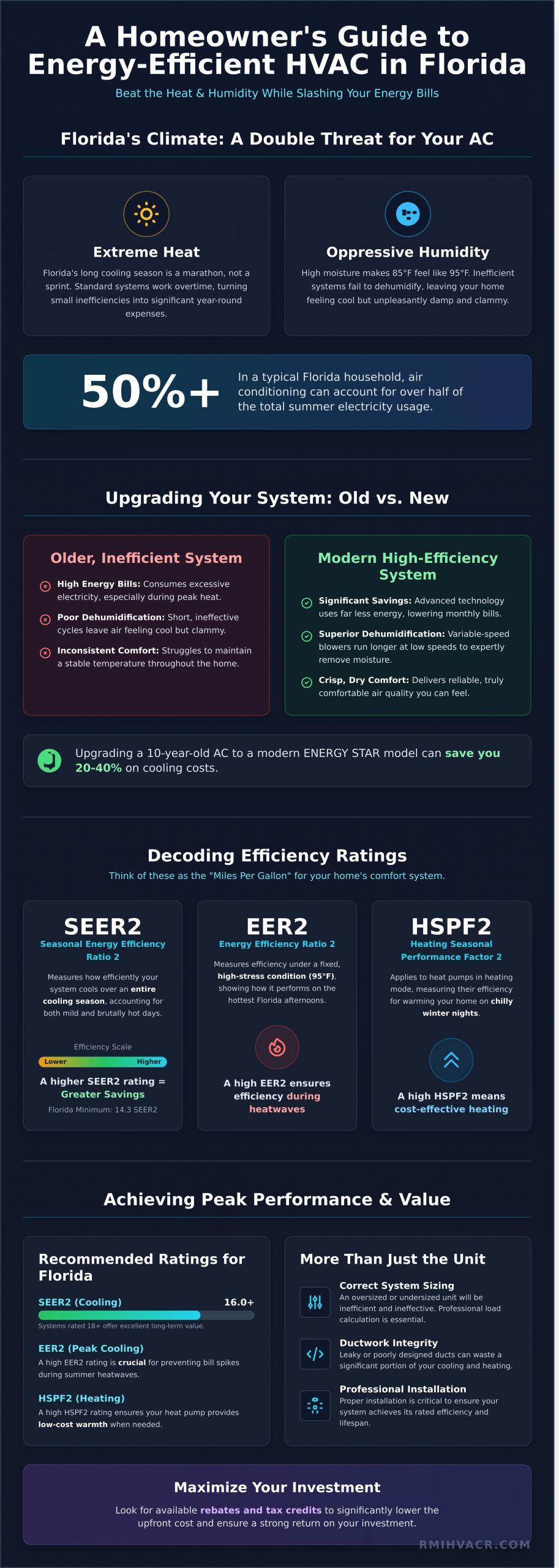
Living in the Sunshine State means enjoying beautiful weather, but it also means your home’s cooling system works overtime. Standard Heating, ventilation, and air conditioning (HVAC) systems can struggle to keep up with the persistent heat and oppressive humidity, leading to high energy consumption and uncomfortable indoor conditions. For Florida homeowners, choosing an energy-efficient model isn’t just an upgrade-it’s a crucial investment in both lower monthly bills and superior home comfort. In a typical Florida household, air conditioning can account for 50% or more of the total summer electricity usage, making efficiency the single most impactful factor in controlling your utility costs.
The Double Threat: Extreme Heat and Humidity
Florida’s climate delivers a one-two punch. It’s not just the high temperatures; it’s the heavy, moisture-laden air that makes 85°F feel like 95°F. Your air conditioner has two jobs: lowering the temperature and removing this excess moisture. Older, less efficient systems struggle with dehumidification, often running in short, ineffective cycles that leave your home feeling cool but unpleasantly clammy. Modern, high-efficiency units are engineered with advanced features like variable-speed blowers that run longer at lower speeds, expertly wringing moisture from the air for a crisp, truly comfortable feel.
The Long Cooling Season: A Marathon, Not a Sprint
Unlike in other parts of the country, air conditioning in Florida is a year-round necessity, not a seasonal convenience. This constant operation turns small inefficiencies into significant expenses over time. According to the U.S. Department of Energy, replacing an air conditioner that is just 10 years old with a modern ENERGY STAR model can save you 20-40% on your cooling costs. This relentless demand is why selecting from the best energy efficient hvac systems florida has to offer is a financial necessity. These reliable systems are built for endurance, delivering consistent performance and peace of mind month after month.
Decoding Efficiency Ratings: What SEER2, EER2, and HSPF2 Really Mean
When you shop for a new air conditioner, you’ll see a lot of acronyms that can feel overwhelming. Think of these ratings-SEER2, EER2, and HSPF2-as the “miles per gallon” for your home’s comfort system. They tell you exactly how much cooling or heating you get for every dollar you spend on electricity. Understanding these numbers is the first step in selecting the truly energy efficient hvac systems florida residents need to lower their utility bills. For those who want a deeper technical dive, major manufacturers offer guides on Understanding SEER2, EER2, and HSPF2, but here’s what’s most important for your home.
As of 2023, the Department of Energy has updated testing standards from the old SEER rating to the more rigorous SEER2, which better reflects real-world conditions. This ensures the ratings you see are more accurate than ever.
SEER2: Your System’s Overall Cooling Efficiency
SEER2 stands for Seasonal Energy Efficiency Ratio 2. This number measures how efficiently your air conditioner or heat pump cools your home over an entire cooling season, factoring in both brutally hot days and milder ones. A higher SEER2 rating means the system uses less energy to do its job, leading to greater potential savings. In Florida, the minimum required rating for new split-system air conditioners is 14.3 SEER2.
EER2: Performance Under Peak Load
EER2, or Energy Efficiency Ratio 2, measures a unit’s efficiency at a fixed, high-stress condition (95°F outside temperature). This rating is a crucial indicator of how well your system will perform during the peak of a sweltering Florida afternoon. While SEER2 gives you the big picture, a high EER2 rating ensures your system remains efficient and effective when you need it most, preventing your energy bills from skyrocketing during a heatwave.
HSPF2: The Rating for Heating (Yes, Even in Florida!)
HSPF2 stands for Heating Seasonal Performance Factor 2 and applies specifically to heat pumps operating in heating mode. While we don’t face harsh winters, those chilly winter nights still require reliable heating. An efficient heat pump with a high HSPF2 rating can warm your home for a fraction of the cost of older, inefficient electric resistance heaters. This rating ensures you stay comfortable and save money year-round.
- SEER2 (Cooling): 16.0 or higher for significant savings. Systems rated 18+ offer excellent long-term value.
- EER2 (Peak Cooling): 11.5 or higher to handle intense summer heat efficiently.
- HSPF2 (Heating): 8.5 or higher for cost-effective warmth during cold snaps.
Key Technologies Driving Modern Energy-Efficient HVAC
While high SEER2 ratings are a great starting point, the real power behind today’s efficiency comes from advanced internal components. Understanding this hardware is crucial for selecting the best energy efficient hvac systems florida homeowners can rely on. These technologies don’t just lower your utility bills; they deliver a level of quiet, consistent comfort that older systems simply can’t match.
Variable-Speed and Multi-Stage Technology
Traditional HVAC systems are single-stage, meaning they are either all-on or all-off. Think of it like a car that only knows stop and full-throttle. Modern variable-speed and multi-stage systems operate more like a car with cruise control. Instead of shutting down completely, they run for longer periods at much lower speeds to precisely maintain your desired temperature. For Florida residents, this provides two major benefits:
- Superior Dehumidification: Longer, slower run times pull significantly more moisture from the air, making your home feel cooler and more comfortable at a higher thermostat setting.
- Consistent Comfort: By avoiding drastic on/off cycles, these systems eliminate the hot and cold spots common with older units, ensuring steady temperatures in every room.
Inverter-Driven Compressors: The Brain of the System
The compressor is the heart of your air conditioner, responsible for circulating refrigerant. An inverter-driven compressor acts as the system’s brain, constantly adjusting its speed in tiny increments to match the exact cooling demand of your home. This technology avoids the massive energy spike required to start a traditional compressor, leading to remarkable efficiency gains and a much quieter operation you’ll barely notice.
Modern Heat Pumps: The All-in-One Solution for Florida
A heat pump is an air conditioner that can also run in reverse to provide highly efficient heating. This makes it a perfect year-round comfort solution for Florida’s climate. They work by moving heat, not creating it with inefficient electric resistance coils. Forget the old myth that heat pumps don’t work in the cold; today’s advanced models are incredibly effective in Florida’s mild winters, making them the most reliable and cost-effective choice for both cooling and heating.
Choosing the Right System: Sizing, Ductwork, and Smart Controls
Selecting a high-efficiency model is only the first step. The performance and lifespan of the best energy efficient hvac systems Florida has to offer depend entirely on proper installation and a well-maintained supporting infrastructure. A state-of-the-art unit connected to faulty ductwork or improperly sized for your home will fail to deliver the promised savings and comfort. Relying on a certified, experienced professional is the only way to guarantee your investment pays off.
To ensure a successful upgrade, it’s crucial to avoid these common pitfalls and focus on three key areas: system sizing, ductwork integrity, and intelligent controls.
Proper Sizing: Bigger Isn’t Better
One of the most frequent mistakes is assuming a larger AC unit provides better cooling. In reality, an oversized system is just as problematic as an undersized one. An oversized unit will cool the air too quickly and shut off before it can remove Florida’s heavy humidity, leaving your home feeling cool but clammy. This constant starting and stopping, known as short-cycling, also causes excessive wear and tear. Conversely, an undersized unit will run nonstop, struggling to keep up and driving your energy bills through the roof. The only way to ensure a perfect fit is with a professional Manual J load calculation, which analyzes your home’s specific cooling needs.
Don’t Ignore Your Ductwork
Your ductwork is the delivery system for all that conditioned air. If it’s leaky, poorly insulated, or improperly designed, you could be losing up to 30% of your cooling power into the attic or crawlspace before it ever reaches your rooms. Before installing a new system, a thorough ductwork inspection by a certified technician is essential. Sealing leaks and ensuring proper insulation can dramatically boost your new system’s efficiency, lower energy costs, and improve indoor air quality. Ask about our comprehensive ductwork services.
The Role of Smart Thermostats
A smart thermostat is the brain of your modern HVAC system. These devices go far beyond simple programmable schedules by learning your family’s patterns and adjusting temperatures automatically for maximum efficiency. Key features include:
- Remote Access: Adjust your home’s temperature from anywhere using your smartphone.
- Geofencing: Automatically enters an energy-saving mode when you leave and cools your home before you return.
- Energy Reports: Track your usage and see exactly how much you’re saving each month.
For the latest variable-speed systems, a “communicating” smart thermostat is essential, allowing the thermostat and HVAC unit to share data and fine-tune performance for unparalleled comfort and efficiency.
Maximizing Your Investment: Rebates, Tax Credits, and ROI
While the initial price of a high-efficiency unit can seem higher, it’s a mistake to view it as just an expense. Upgrading is a powerful investment in your home’s value and your family’s comfort. When you factor in federal tax credits, local utility rebates, and massive long-term energy savings, the most advanced energy efficient hvac systems Florida homeowners can choose become remarkably affordable. Let’s break down how you can save.
Federal Energy Tax Credits
The Inflation Reduction Act provides significant financial incentives for homeowners who invest in energy efficiency. Under the Energy Efficient Home Improvement Credit (25C), you may be eligible for a tax credit of 30% of the total project cost. The maximum credit available is:
- Up to $2,000 for qualifying electric heat pump systems.
- Up to $600 for qualifying central air conditioning systems.
To qualify, the system must meet specific high-efficiency standards. Our expert team can help you identify systems that meet these strict requirements. Please consult a tax professional to confirm your personal eligibility.
Local Florida Utility Rebates
Florida’s major utility providers want to help you save energy, too. Companies like Florida Power & Light (FPL) and Duke Energy offer valuable rebates for installing new, high-SEER2 air conditioning systems. These programs are designed to offset the cost of upgrading. The application process can sometimes be complex, but our team at RMI is experienced in navigating these programs to help ensure you receive every dollar you’re entitled to.
You can find more information directly from your provider:
Calculating Your Long-Term Return on Investment (ROI)
A new, high-efficiency system delivers savings every single month. Consider this simple comparison: a modern 18 SEER2 unit can be over 25% more efficient than a 10-year-old 14 SEER system. For a typical Florida home, that can translate into hundreds of dollars in annual savings on your electricity bill.
Beyond energy savings, you also avoid the mounting repair costs and unpredictability of an aging unit. A reliable new system provides peace of mind and protection from unexpected breakdowns. Over its lifespan, an efficient HVAC system doesn’t just keep you comfortable-it often pays for itself. To get a clear picture of your potential savings and explore qualifying systems, contact the trusted experts at RMI for a personalized estimate.
Your Partner for a Cooler, More Efficient Florida Home
In the Sunshine State, a high-performance air conditioner is essential for both comfort and managing high utility bills. Understanding modern ratings like SEER2 and ensuring your system is correctly sized are the first steps toward significant long-term savings. Choosing the right energy efficient hvac systems florida residents can rely on is about more than a new unit; it’s about a complete comfort solution that leverages advanced technology and maximizes your return on investment.
Navigating these options can feel complex, but you don’t have to do it alone. Since 1999, RMI Heating and Air Conditioning has been Central Florida’s trusted expert in home cooling. You can count on our certified, experienced technicians to design a system that meets your specific needs, delivering reliable performance and guaranteed customer satisfaction.
Ready to experience the difference a modern, high-efficiency system can make? Request a free, no-obligation estimate on a high-efficiency system.
Let us help you achieve the cool, dependable comfort you deserve.
Frequently Asked Questions
What is a good SEER2 rating for a home in Central Florida?
For Central Florida’s intense heat and humidity, a SEER2 rating of 16 or higher is an excellent target for significant energy savings and superior comfort. While the current minimum is 14.3, investing in a higher-rated system provides more efficient cooling and lower monthly bills. Our certified experts can help you evaluate models in the 16-18 SEER2 range to find the most reliable and cost-effective solution for your home, guaranteeing optimal performance.
How much money can I realistically save per year with an energy-efficient AC?
Upgrading to a modern, energy-efficient air conditioner can lead to substantial savings. For example, replacing an older 10 SEER unit with a new 16 SEER2 system can reduce your cooling costs by over 35% annually. For an average Florida household, this can translate to hundreds of dollars in savings each year. Our team provides clear, upfront estimates to show you the long-term financial benefits of investing in a high-efficiency system.
Are heat pumps a good choice for heating during Florida’s mild winters?
Absolutely. Heat pumps are an outstandingly efficient choice for Florida’s climate. Instead of generating heat, they transfer it from the outside air, which is a highly effective process during our mild winters. This makes them significantly more energy-efficient than traditional electric resistance heaters. A modern heat pump provides reliable heating when you need it and doubles as a high-efficiency air conditioner in the summer, offering a dependable year-round comfort solution.
Does an energy-efficient HVAC system require special or more frequent maintenance?
High-efficiency systems do not require more frequent maintenance, but consistent, expert care is essential to maintain their peak performance and efficiency ratings. We recommend the same reliable semi-annual tune-ups that we advise for all systems. Professional service ensures the advanced components are clean and calibrated correctly, protecting your investment, upholding the manufacturer’s warranty, and guaranteeing your system runs efficiently for years to come.
How long do new high-efficiency air conditioners typically last in Florida?
In Florida’s demanding climate, a new, well-maintained high-efficiency air conditioner can be expected to last between 12 to 15 years. The longevity of these systems is directly tied to a quality installation by certified technicians and consistent professional maintenance. With our trusted service plans, we help ensure your system operates reliably and efficiently, maximizing its lifespan and delivering the dependable cooling you count on year after year.
Can I get a tax credit and a utility rebate for the same new HVAC system?
Yes, in many cases, you can combine federal tax credits with local utility rebates for the same qualifying system. These incentives are designed to make upgrading to energy efficient hvac systems florida homeowners can afford. It is important to verify the specific eligibility requirements for each program, as they can change. Our expert team stays current on these programs and can help you identify qualifying units and navigate the application process to maximize your savings.