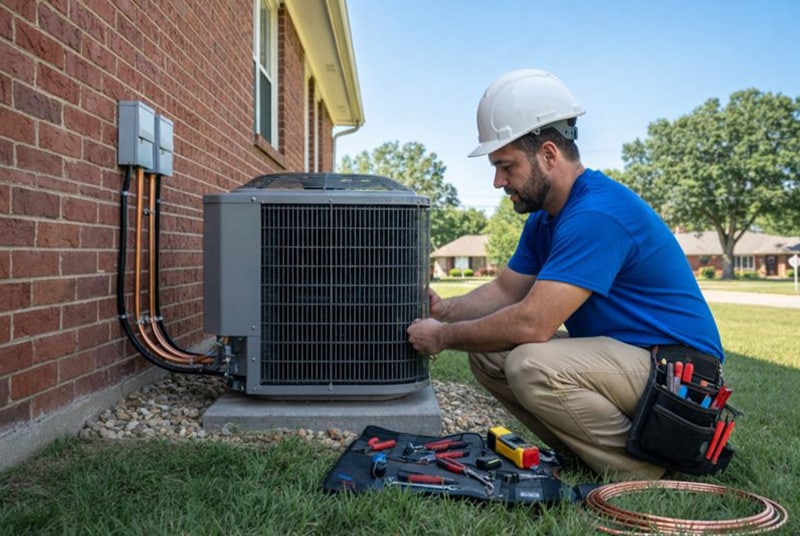
Misdiagnosis is usually not dishonesty. It is what happens when a system gets assessed quickly, by age, without anyone measuring what it is actually doing. These are the five faults we most often find behind a replacement quote, and all five are repairs.
A failed capacitor or contactor
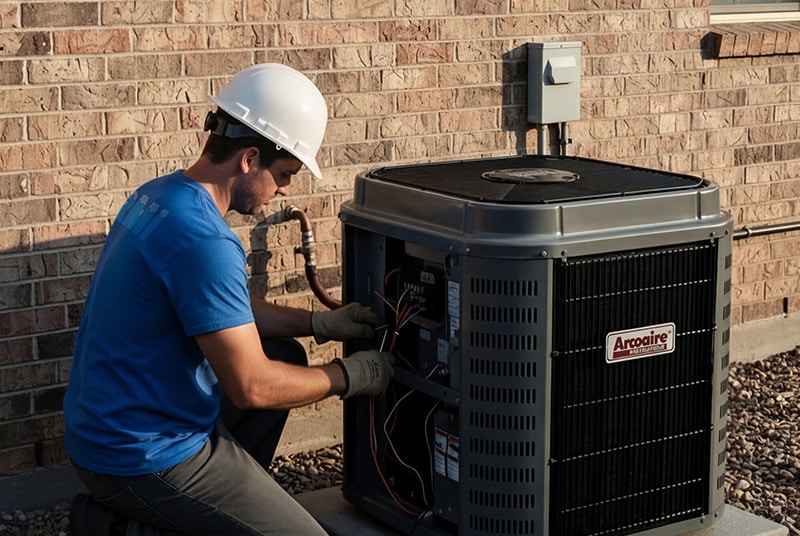
The cheapest parts on the system and the most common reason an outdoor unit will not start. A dead capacitor presents exactly as “the compressor is gone,” because the compressor will not run without one. The difference between these two diagnoses is the difference between a same-day part and a new system.
A refrigerant leak read as a dead compressor
A system low on charge loses capacity, runs long and eventually trips on pressure. It looks and sounds like a failing compressor. The honest work is finding the leak, and where it is matters: a leaking service valve or line set is a straightforward repair, an evaporator coil is a bigger but still bounded job. Nobody can tell you which without looking.
A clogged drain and a tripped float switch
Almost every Florida system has a safety switch that kills power when the condensate drain backs up. The result is a system that is completely dead, with no lights and no response, which reads as catastrophic. It is a blocked drain line.
A dirty coil or restricted airflow
A fouled indoor or outdoor coil, a collapsed flex duct or a filter nobody has changed will strangle a healthy system. The symptoms are weak cooling, a frozen line set, high bills and long run times, which is the same symptom list as a worn-out system. Clean it and measure again before condemning anything.
A reversing valve or defrost fault on a heat pump
Central Florida is heat pump country, and the parts unique to a heat pump are the ones least often checked. A stuck reversing valve means the system will not change over. A failed defrost board leaves the outdoor coil iced. Either one can be read as “the system is finished.” See our heat pump repair page for what actually fails on these.
The age heuristic is not a diagnosis
“It is twelve years old, you may as well replace it” is a rule of thumb, not a finding. Age tells you the probability of failure across a population of systems. It tells you nothing about the specific unit in front of you. A well-maintained fifteen-year-old system with sound ductwork can have years left. A poorly installed six-year-old system can be genuinely finished. Only measurement distinguishes them.
The ductwork gets blamed on the equipment
In this climate the distribution system is often the real constraint. A room that never cools, a house that holds temperature but feels humid, uneven performance floor to floor: those are usually duct problems, and replacing the condenser will not fix any of them. We look at the ductwork before we look at the equipment, because a new system pushed through the same bad ducts produces the same complaint and a much larger invoice.
What a real diagnosis measures
A diagnosis that supports a replacement recommendation should involve numbers, not impressions. Superheat and subcooling to establish the actual refrigerant charge. Static pressure across the air handler to find airflow restriction. Amp draw on the compressor and fan motors against their rated values. Temperature split across the coil. Capacitor microfarads against the rating stamped on it. Electrical connections and contactor condition. If the visit that produced your quote included none of those, it was an estimate, not a diagnosis.
Questions worth asking the first contractor
You can often tell how solid a replacement recommendation is without knowing anything about HVAC, just by asking four questions:
- What specifically failed? A part name, not “the system.”
- What does it cost to repair that part? If nobody priced the repair, nobody compared it to replacement.
- How much life does the repair buy? An honest answer here is a range, and sometimes it is short. That is fine, it is still an answer.
- What did you measure? Charge, static pressure, amp draw. If the response is about the system’s age, you have your answer.
A contractor confident in their diagnosis will answer all four without difficulty.
When replacement genuinely is the right call
Sometimes it is, and we will tell you so. A compressor failure on a system out of warranty, a leaking evaporator coil on aging equipment where the repair approaches replacement cost, a system so undersized or oversized for the house that no repair fixes the comfort problem, or repeated failures that have stopped being isolated events. In those cases we will give you the numbers and let you decide, and we will size the replacement properly rather than matching the tag on the old unit. See select your comfort system and AC installation.
How our second opinion works
It is a paid diagnostic visit, and that is deliberate. A free visit has to be paid for somehow, and the usual way is by selling something at the end of it. Charging for the diagnosis is what lets us tell you the answer is a fifteen-dollar part.
Bring us whatever the first company gave you: the quote, the written diagnosis, photos, anything. We will evaluate the equipment ourselves and give you three numbers, the repair cost, how much life that repair realistically buys, and what replacement costs installed. You decide with all three in front of you rather than one.
Much of our work is on systems another company already said were finished. Call 407-405-2658.