
Cost to Repair Furnace Ignitor: 2026 Price Guide & Expert Repair Tips
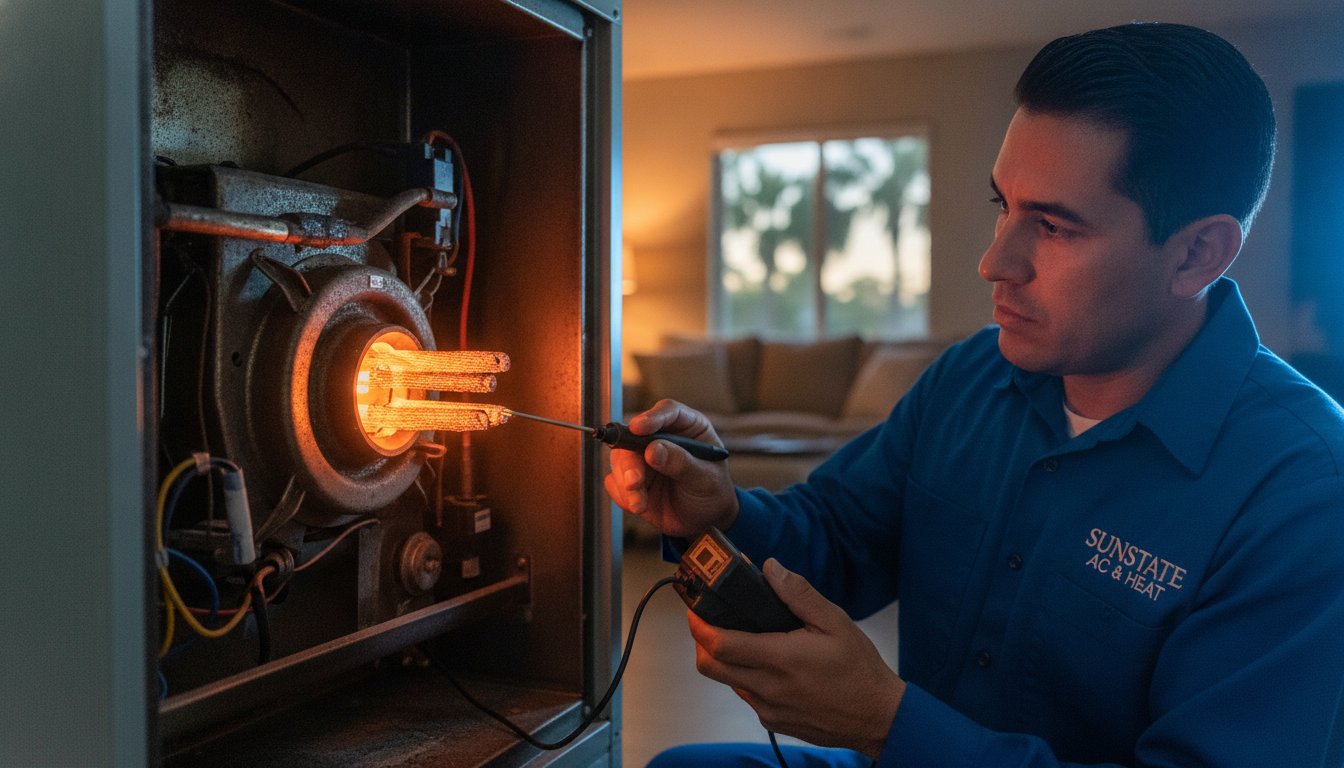
Your furnace clicks, the blower hums, but no heat comes. On a cold Florida night, that silence from your vents isn’t just uncomfortable — it’s urgent. If you’re already searching for the cost to repair furnace ignitor, you’re probably wondering whether you’re facing a minor fix or a major bill, and you need a straight answer fast.
That frustration is completely valid. HVAC repairs carry a reputation for surprise fees and confusing technical explanations, and the last thing you need when your home is cold is more uncertainty. Here’s the good news: a furnace ignitor is one of the most straightforward heating repairs a technician can perform, and knowing what drives the price puts you firmly in control of the situation.
In this guide, you’ll get a clear, honest breakdown of what ignitor repairs actually cost in 2026, what factors push that number up or down, how to spot a failing ignitor before it leaves you without heat, and why a correct diagnosis matters just as much as the repair itself. By the end, you’ll know exactly what to expect and how to get your home warm again without overpaying.
Key Takeaways
- The cost to repair furnace ignitor typically includes three components — a diagnostic fee, the part itself, and labor — and knowing how each is priced helps you evaluate any quote with confidence.
- Hot surface ignitors are fragile by design: even a single touch with bare hands can cause immediate failure, making professional handling essential rather than optional.
- Your furnace will give you clear warning signs before it quits entirely — learning to recognize them early can mean the difference between a simple repair and an emergency call.
- Central Florida’s heating season is short but intense, and local market rates for ignitor repairs differ from national averages in ways that directly affect what you should expect to pay.
- A correct diagnosis matters as much as the repair itself — an ignitor that keeps failing may be pointing to a deeper system issue that a qualified technician needs to identify.
What is a Furnace Ignitor and Why Does it Fail?
Think of the furnace ignitor as the critical bridge between your gas valve and your heat exchanger: without it functioning correctly, gas won’t ignite, and your system simply pushes cold air through your home. It’s the component that makes heat possible, and it’s also one of the first things a qualified technician checks when diagnosing a no-heat call. Understanding what it does, and why it fails, is the first step toward making sense of the cost to repair furnace ignitor when the time comes.
Modern furnaces have moved well past the standing pilot light era. Today’s systems rely on Hot Surface Ignitors (HSI), ceramic heating elements that glow at extreme temperatures to ignite the gas burners safely and reliably. To understand how heating elements work at a material science level, the physics are straightforward: electrical resistance generates intense heat, and that heat triggers combustion. In practice, though, these components operate under significant stress every single heating cycle.
Silicon Carbide vs. Silicon Nitride Ignitors
Not all HSIs are built the same. The two dominant materials you’ll encounter are silicon carbide and silicon nitride, and they behave very differently in the field.
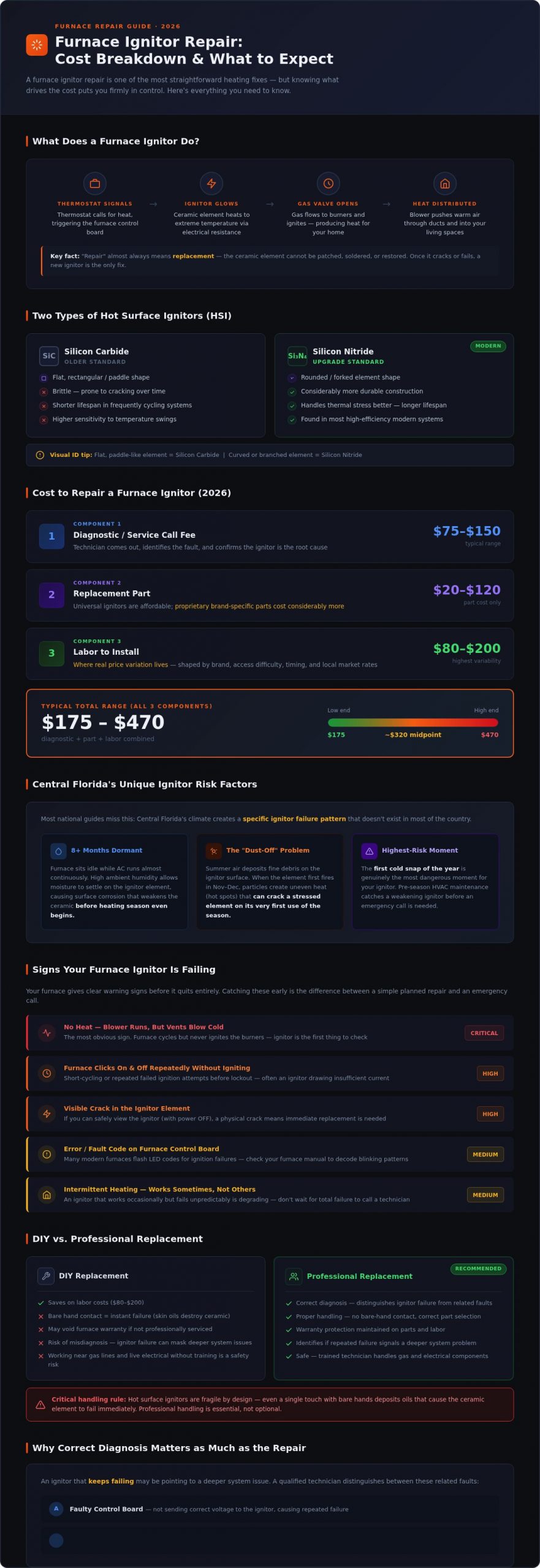
- Silicon Carbide: The older standard. Recognizable by its flat, rectangular shape, this material is brittle and prone to cracking over time. Lifespans can be relatively short, particularly in systems that cycle frequently or experience temperature swings.
- Silicon Nitride: The modern upgrade found in most high-efficiency systems. It typically has a rounded or forked element shape and is considerably more durable. Silicon nitride handles thermal stress better and tends to outlast its silicon carbide counterpart by a meaningful margin.
If you’re unsure which type your furnace uses, the element’s shape is your clearest visual cue. A flat, paddle-like element points to silicon carbide; a curved or branched element usually indicates silicon nitride.
The Role of Central Florida Humidity in Ignitor Failure
Here’s what most national guides completely miss: Central Florida’s climate creates a specific ignitor failure pattern that doesn’t exist in most of the country. Your furnace sits dormant for the better part of eight months while your air conditioning runs almost continuously. During that stretch, high ambient humidity allows microscopic moisture to settle on and around the ignitor element. Over time, this contributes to surface corrosion that weakens the ceramic material before the heating season even begins.
There’s also what technicians sometimes call the “dust-off” problem. Summer air movement through the system deposits fine debris directly onto the ignitor surface. When that element first fires up in November or December, those particles create uneven heat distribution, or hot spots, that can crack an already-stressed element on its very first use of the season.
That first cold snap isn’t just uncomfortable. It’s genuinely the highest-risk moment for your ignitor all year. Staying ahead of it with routine HVAC maintenance before the heating season starts is the most reliable way to catch a weakening ignitor before it fails entirely, turning what would be a planned service call into an urgent repair.
Breakdown: Cost to Repair Furnace Ignitor in 2026
When your furnace stops producing heat, the bill you receive isn’t a single charge. It’s three separate costs bundled together: a diagnostic or service call fee, the replacement part itself, and the labor to install it. Understanding each component is the clearest way to evaluate whether a quote you receive is fair or inflated.
The part cost is typically the smallest piece of the puzzle. Universal ignitors are widely available and relatively inexpensive. Proprietary ignitors designed for specific brands, however, can cost considerably more. Labor is where the real variation lives, and it’s shaped by factors most homeowners never think to ask about.
One thing worth clarifying upfront: when technicians talk about the cost to repair furnace ignitor, they almost always mean replacement, not repair. The ceramic element itself cannot be patched, soldered, or restored. Once it cracks or fails to draw proper current, the only fix is a new one. The word “repair” in this context simply refers to restoring your furnace to working order, not rebuilding the component.
Factors That Influence the Final Price
Three variables consistently move the price up or down:
- Furnace brand: Manufacturers like Trane and Carrier sometimes require proprietary ignitors that aren’t interchangeable with universal parts. When a universal replacement isn’t an option, the part cost rises, and so does the total bill.
- Accessibility: A technician who can reach the burner assembly in minutes charges for minutes. If your furnace is in a tight utility closet, an attic, or requires significant disassembly to access the ignitor, expect the labor portion to reflect that added time.
- Warranty status: If your furnace is still within its manufacturer’s warranty period, the part itself may be covered. Labor typically isn’t. Always check your documentation before authorizing any repair, because even a partial warranty can meaningfully reduce your out-of-pocket cost.
After-hours and weekend calls carry a premium. Emergency service rates can be notably higher than standard business-hours pricing, which is a legitimate reflection of technician availability and overhead, not an arbitrary markup. If your situation isn’t urgent, scheduling during regular hours is the straightforward way to avoid that surcharge. When it is urgent, the cost of a warm home that night is usually worth it.
Diagnostic Fee vs. Total Repair Cost
The diagnostic fee is the part of the bill that generates the most confusion and the most complaints. Reddit threads are full of homeowners frustrated about paying hundreds of dollars for what they later learned was a part that costs a fraction of that. That frustration is understandable, but it misses what the diagnostic fee actually covers.
A thorough diagnostic isn’t just a technician glancing at the ignitor. It includes verifying gas pressure, measuring the ignitor’s electrical resistance, checking the control board’s output signal, and inspecting the heat exchanger for safety concerns. The U.S. Consumer Product Safety Commission recommends professional inspection of all fuel-burning home heating systems precisely because these safety checks aren’t optional extras; they’re the standard a responsible technician follows every time.
There’s also a practical reason to value a well-stocked service vehicle. When a technician arrives with common ignitor replacements already on the truck, you pay for one visit, not two. A return trip to retrieve a part isn’t just inconvenient; it doubles the labor time you’re billed for. RMI has operated across Central Florida since 1999 with fully stocked trucks specifically to eliminate that scenario, meaning most ignitor replacements are completed on the first visit.
Be cautious of unusually low diagnostic quotes. A significantly discounted service call sometimes leads to unexpected “additional labor” charges once the technician is already in your home. A transparent quote covers the diagnostic, the part, and the labor to install it. If a company can’t give you that structure upfront, that’s worth noting before you book. For a reliable assessment of what your specific system needs, scheduling a professional furnace repair evaluation is the right starting point.
DIY vs. Professional Furnace Ignitor Replacement
A replacement ignitor costs roughly $20 to $50 at most hardware stores. That price point makes DIY tempting, and several guides online will tell you it’s a straightforward swap. What those guides consistently underplay is how easily the repair goes wrong, and what it costs when it does. A $30 part can become a $500 repair if the gas valve is accidentally damaged during disassembly or if the burner assembly isn’t reseated and sealed correctly afterward.
The most underappreciated risk isn’t even mechanical. It’s biological. Hot surface ignitors, particularly modern silicon nitride elements, are extraordinarily sensitive to skin oils. Handling the ceramic element with bare hands deposits a thin layer of oil onto the surface. When that element heats to operating temperature, those oils create localized hot spots that crack the element, often on its very first firing cycle. You’d install a brand-new part and get an immediate failure with no obvious explanation. Gloves aren’t optional; they’re the entire difference between a successful repair and a repeat service call.
Gas reassembly is the other serious concern. If the burner assembly isn’t reseated with the correct fastener torque and gasket alignment, you can introduce a small leak that doesn’t trigger an alarm immediately but creates a genuine safety hazard over time. This is a risk that directly affects the total cost to repair furnace ignitor when a second technician has to come in and undo a DIY attempt before starting the actual repair.
There’s also the diagnostic dimension that DIY entirely skips. A professional doesn’t just swap the part; they identify why it failed. Excessive voltage from a failing control board will destroy a new ignitor just as quickly as it destroyed the old one. A bad ground in the circuit creates the same outcome. Without checking those upstream causes, you’re replacing parts without solving the problem.
When DIY Might Be Appropriate
Mechanical confidence, the right tools, and access to a local parts supplier that sells to the public are the minimum requirements. Critically, the replacement part must match your furnace’s exact model number. An electrical mismatch, even a minor one in resistance rating, shortens the new ignitor’s lifespan significantly. For most Orlando homeowners, the combination of humidity-related fragility, gas line involvement, and the value of a simultaneous safety inspection makes professional furnace repair the more practical choice.
The Value of a Professional Safety Inspection
When a technician opens your furnace to replace the ignitor, three additional checks should happen as a matter of course: a visual inspection of the heat exchanger for cracks that could allow combustion gases into your living space, a cleaning and resistance check of the flame sensor (the most common companion failure to a bad ignitor), and a verification of gas manifold pressure. Incorrect manifold pressure is a leading cause of premature ignitor burnout, and it’s invisible without the right instruments. Skipping those checks to save time is how the same repair shows up on your bill again next season.
Signs Your Furnace Ignitor is Bad: Troubleshooting Guide
Before you call a technician or start calculating the cost to repair furnace ignitor, there’s a logical sequence of checks you can run from inside your home. None of them require tools or technical knowledge. What they require is knowing what to look for, and what order to look for it in.
Step 1: Start at the thermostat. Confirm the system is set to “Heat,” not “Cool” or “Fan Only,” and that the target temperature is at least a few degrees above the current room temperature. Then check your electrical panel for a tripped breaker on the furnace circuit. These take thirty seconds and eliminate the most embarrassing service call outcome.
Step 2: Listen during startup. Stand near the furnace and turn the thermostat up. You should hear the inducer motor spin up, followed by a brief pause, then the gas valve opening. A distinct clicking sound without any ignition attempt, or a complete absence of that click, tells you the control board is signaling the ignitor but nothing is responding. That’s a meaningful diagnostic clue.
Step 3: Watch the control board LED. Most modern furnaces have a small blinking LED on the control board, visible through a small window or when the panel is removed. That blink pattern is a fault code. Count the flashes and consult the legend printed on the inside of the furnace door. Codes pointing to “ignitor failure,” “pressure switch open,” or “flame not proven” each tell a different story, and a technician will reference these codes immediately upon arrival.
Common Symptoms of a Failing Ignitor
- Short cycling: The furnace fires briefly, then shuts down within seconds. The burners light, the flame sensor can’t confirm a stable flame, and the system locks out. This pattern often repeats two or three times before the furnace goes into full lockout mode.
- Visible cracks or white hot spots: On silicon carbide elements especially, hairline fractures or discolored patches on the black ceramic surface are a clear visual confirmation of failure.
- Tripped circuit breaker: A shorted ignitor draws more amperage than the circuit expects. If your furnace breaker trips repeatedly with no other obvious cause, the ignitor is a strong suspect.
The ‘No Glow’ Test: A Homeowner’s First Check
Many furnaces have a small sight glass on the burner compartment door. During the startup sequence, a functioning hot surface ignitor will glow visibly orange or red-orange within about 30 to 60 seconds of the thermostat calling for heat. If the inducer motor runs but you see no glow through that window, the ignitor isn’t energizing. That’s your clearest homeowner-level confirmation that the element has failed.
One absolute rule: never attempt to manually light a modern furnace with a match or lighter. These systems rely on precise gas valve timing and pressure sequencing. Introducing an open flame outside that sequence creates a genuine safety hazard and won’t resolve the underlying problem.
Central Florida’s long off-season makes that first startup of the year the highest-risk moment, and these symptoms are most likely to appear then. Catching them early keeps a manageable repair from becoming an emergency. If you’re seeing any of these signs, schedule a furnace repair evaluation with RMI before the problem escalates into a full no-heat situation.
Trusted Furnace Repair in Orlando: Why Choose RMI?
There’s a meaningful difference between a company that repairs furnaces and one that has spent over 25 years learning exactly how Central Florida homes heat and cool. RMI has served Orlando and the surrounding region since 1999, and that history isn’t just a number on a website. It represents thousands of heating calls across the specific climate conditions, equipment types, and seasonal patterns that define this market. When you’re calculating the cost to repair furnace ignitor and trying to decide who to trust with the job, that depth of local experience matters in ways a newer company simply can’t replicate.
Transparent pricing is a commitment, not a marketing phrase. RMI structures every repair quote to cover the diagnostic, the part, and the labor clearly and upfront. There are no separate “environmental fees,” no surprise line items added once the technician is already in your home, and no inflated emergency markups applied to regular clients. You know what you’re paying before work begins.
Every ignitor replacement RMI performs includes a full combustion safety check as standard practice. That means the heat exchanger gets inspected, the flame sensor gets cleaned and tested, and gas manifold pressure gets verified before the technician leaves. These aren’t add-ons. They’re the baseline for a repair done correctly.
24/7 Emergency Support When You Need It Most
Cold snaps in Central Florida don’t follow a schedule. When temperatures drop across Orlando, Kissimmee, and Sanford simultaneously, heating calls surge. RMI’s dispatch team is structured to handle that volume without putting customers on indefinite hold. Fully stocked service vehicles mean technicians arrive carrying the most common ignitor replacements, so the majority of repairs are completed on the first visit rather than requiring a return trip for parts.
That preparedness is intentional. It respects your time and eliminates the frustration of a two-visit repair when one will do. If your furnace stops working tonight, schedule your furnace repair with RMI and get a technician moving toward your home rather than waiting until morning.
Beyond the Ignitor: Total System Health
A single repair is a fix. A well-maintained system is protection. RMI recommends scheduling an annual HVAC maintenance tune-up before Florida’s heating season begins, ideally in October before that first cold snap arrives. That appointment catches a weakening ignitor, a dirty flame sensor, or incorrect gas pressure before any of them become an emergency. It’s also the most reliable way to keep the cost to repair furnace ignitor predictable rather than urgent.
Every heating repair and installation RMI completes is backed by a 100% satisfaction guarantee. The goal isn’t just a furnace that fires once. It’s a system you can rely on through every cold night Florida’s unpredictable winters deliver.
Get Your Heat Back with Confidence
A failed furnace ignitor doesn’t have to mean a stressful, expensive ordeal. The cost to repair furnace ignitor is predictable when you understand what drives the price: the diagnostic, the part, and the labor. Knowing the warning signs early keeps a straightforward repair from turning into an emergency call, and choosing a qualified technician ensures the root cause gets addressed, not just the symptom.
When you need reliable heating service in Central Florida, experience and preparedness matter. RMI has served Orlando homeowners since 1999, with fully stocked trucks that resolve most ignitor replacements on the first visit and 24/7 emergency support available when your heat can’t wait until morning.
Don’t spend another cold night guessing what’s wrong. Restore your home’s warmth today by scheduling your professional furnace repair with RMI. Your comfort is closer than you think.
Frequently Asked Questions About Furnace Ignitor Repair
How much does a furnace ignitor typically cost to replace in 2026?
The total cost to repair furnace ignitor covers three components: a diagnostic fee, the replacement part, and labor. Universal ignitor parts are generally inexpensive, while proprietary brand-specific components cost more. Labor rates vary based on accessibility, time of day, and local market conditions. Getting a quote that clearly separates all three components before work begins is the most reliable way to evaluate whether you’re being charged fairly.
Can I still run my furnace if the ignitor is broken?
No. Without a functioning ignitor, your gas valve won’t open, and your furnace will simply push unheated air through your vents or shut down entirely after a failed startup sequence. Attempting to force the system through repeated manual resets doesn’t fix the underlying problem and can trigger a full control board lockout. The safest path is a professional diagnosis before continuing to operate the system.
How long should a furnace ignitor last before needing repair?
Silicon nitride ignitors, the type found in most modern high-efficiency furnaces, generally outlast older silicon carbide elements by a meaningful margin. Actual lifespan varies based on how frequently your system cycles, voltage consistency in your home, and local climate conditions. In Central Florida specifically, the long off-season followed by an abrupt first startup creates stress patterns that can shorten ignitor life compared to regions with consistent heating demand.
Why did my furnace ignitor burn out so fast?
Premature ignitor failure almost always points to an upstream problem. Excessive voltage from a failing control board is a common cause; it pushes more current through the element than it’s rated to handle. Incorrect gas manifold pressure creates uneven combustion that stresses the element from the outside. Handling the ignitor with bare hands during a previous installation deposits skin oils that cause cracking on the first heat cycle. A technician should identify the root cause before simply swapping the part again.
Is a bad ignitor covered under my home warranty?
It depends entirely on your specific policy. Many home warranty plans cover furnace components including the ignitor, but coverage terms vary widely between providers. Some plans exclude failures attributed to lack of maintenance, while others cover parts but not labor. Review your warranty documentation before authorizing any repair, and ask your technician to document the failure cause clearly. That documentation often matters when submitting a claim.
What is the difference between a pilot light and an ignitor?
A pilot light is a small, continuously burning flame used in older furnace designs to ignite the main burners when heat is called for. It burns gas constantly, even when your furnace isn’t actively heating. A hot surface ignitor replaced that design in modern furnaces; it’s an electric ceramic element that heats to ignition temperature only during startup, then shuts off. Modern ignitors are more energy-efficient and eliminate the risk of a pilot light blowing out.
Can I clean a furnace ignitor to make it work again?
No. Unlike a flame sensor, which can sometimes be restored with light cleaning, a hot surface ignitor that has failed cannot be repaired or cleaned back to function. The ceramic element either conducts electricity properly or it doesn’t. If it’s cracked or drawing insufficient current, replacement is the only solution. Attempting to clean or handle a failed ignitor also risks damaging a new one through improper contact before installation.
How do I know if it’s the ignitor or the flame sensor that is bad?
The failure pattern tells the story. If your furnace attempts to start but you see no glow through the sight glass during the startup sequence, the ignitor isn’t energizing. If the burners do light briefly but the system shuts down within seconds, the flame sensor is the more likely culprit; it’s failing to confirm a stable flame to the control board. Both components fail regularly and are often checked together during a professional diagnostic, since one can mask the other’s symptoms.