
Best Temperature to Set Thermostat in Summer Florida: The 2026 Expert Guide
You’ve just opened your latest utility bill to find a charge exceeding $300, yet your Central Florida home still feels sticky and muggy. It’s a common frustration for homeowners who push their systems to the limit only to face rising costs and a persistent fear of the AC unit freezing up. Finding the best temperature to set thermostat in summer florida isn’t just about picking a random number. It’s about understanding how your system handles the relentless heat and humidity while protecting your budget.
Key Takeaways
- Learn the best temperature to set thermostat in summer florida to balance crisp indoor air with significant energy savings.
- Discover the “Golden Zone” for daytime and nighttime settings that keeps your home comfortable without overworking your compressor.
- Understand the mechanical limits of the 20-degree rule to protect your system from freezing up during extreme Central Florida heatwaves.
- Identify how simple upgrades like smart thermostats and improved insulation can naturally lower your home’s cooling load.
- Recognize when a system’s inability to maintain your desired temperature signals a need for a professional diagnostic from a reliable expert.
Why Florida Thermostat Settings Require a Specialized Approach
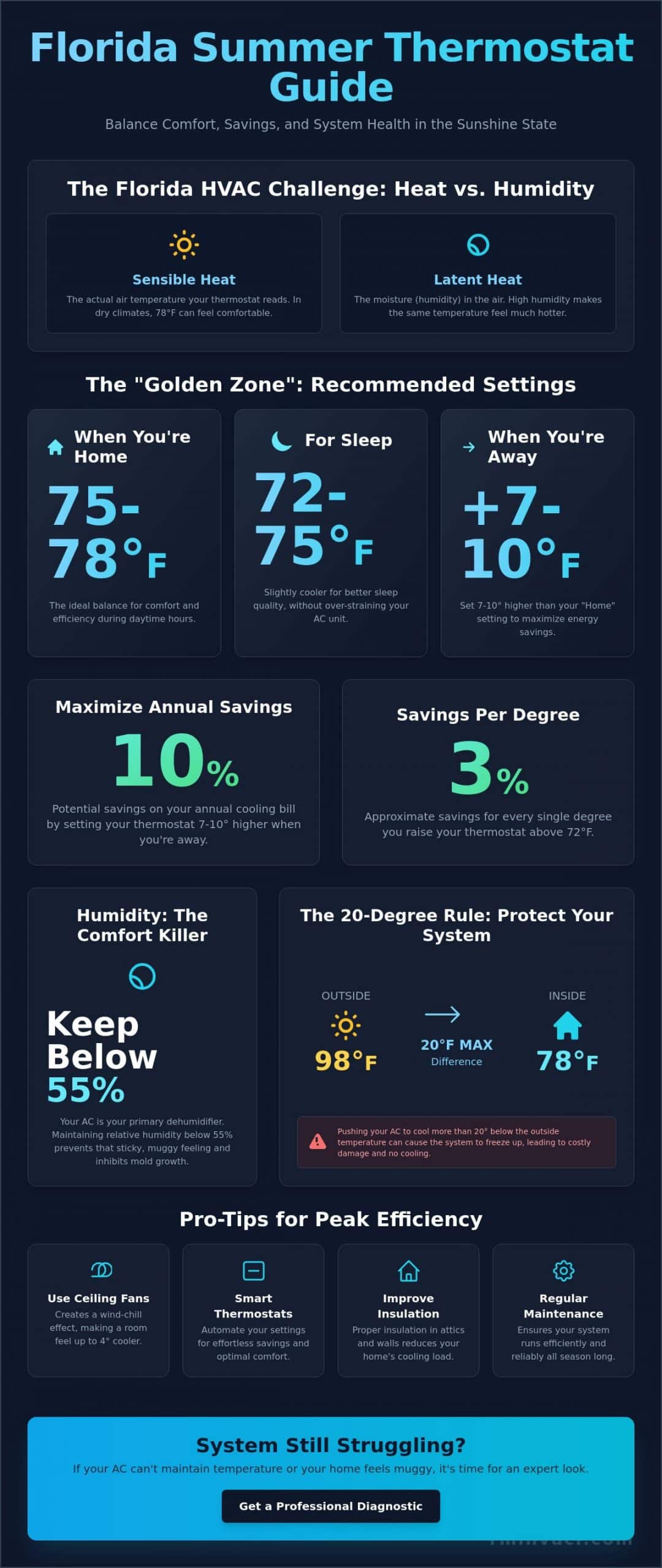
Living in Central Florida means dealing with a climate that doesn’t just get hot; it gets heavy. While national guidelines often suggest 78°F as the standard, many Orlando residents find this setting uncomfortable. This is because Florida homes must manage both sensible heat, the temperature you see on the dial, and latent heat, the moisture in the air. In regions with dry heat, 78°F feels breezy. In Kissimmee or Sanford, that same temperature can feel like a swamp if your system isn’t dialed in. Finding the best temperature to set thermostat in summer florida requires looking past the number on the screen.
Your Heating, ventilation, and air conditioning (HVAC) system works overtime in our region. Unlike northern states, Florida’s cooling season is essentially a year-round operation. This constant demand leads to accelerated wear and tear on compressors and coils. In 2026, outdoor heat indexes have consistently reached record levels. These conditions push older systems to their breaking point. If your unit was installed over a decade ago, it likely struggles to maintain efficiency under these modern thermal loads. Regular air conditioning maintenance and tune-ups are a necessity for system survival in this environment.
The Role of Relative Humidity in Your Comfort
Humidity is the true enemy of comfort. A room at 75°F with 60% humidity feels significantly hotter than a room at 80°F with 40% humidity. Your AC unit acts as your home’s primary dehumidifier. When the system runs longer, moderate cycles, it removes more moisture from the air. Keeping your home below the 55% humidity threshold is critical. Anything higher creates a sticky environment that encourages mold growth. If your house feels muggy even when the air is blowing, your system isn’t effectively managing the latent heat load. This often happens when a system is oversized or failing to cycle correctly.
Central Florida Utility Costs and Thermal Load
Peak demand hours in Orlando and Kissimmee usually occur in the late afternoon. This is when the sun hits west-facing walls and creates a massive thermal load. The type of home you live in dictates how well you retain cool air. Concrete block homes have high thermal mass. They stay cool longer but take more energy to cool down once they heat up. Wood frame homes heat up faster but respond quickly to thermostat changes. Setting and forgetting your thermostat is usually more efficient than making constant manual adjustments. Frequent changes force the system to work harder to overcome the thermal lag of your home’s structure, leading to higher bills.
The Recommended Temperature Ranges for Comfort and Savings
Finding the best temperature to set thermostat in summer florida involves more than just picking a number. It requires a strategy that protects your equipment while keeping your family cool. Most homeowners find success in the “Golden Zone,” which is between 75°F and 78°F during the day. This range provides a comfortable environment without forcing your air conditioner into a non-stop cycle. Every degree you raise your thermostat above 72°F can save you roughly 3% on your monthly cooling costs. Following the U.S. Department of Energy recommendations by aiming for 78°F is the most effective way to lower your overhead.
Daytime Settings: Finding Your Personal Baseline
Start your day at 78°F. If the house feels warm, use the “one-degree-per-hour” adjustment method. Lower the setting by a single degree and wait sixty minutes to see if you feel comfortable. This gives the home’s thermal mass time to adjust. Ceiling fans are your best friend here. A fan doesn’t lower the room’s temperature, but the moving air makes you feel up to 4 degrees cooler. This allows you to keep the thermostat at 78°F while feeling like it’s 74°F. Keep in mind that 75°F is the financial tipping point. Dropping below this often leads to much higher energy consumption in Central Florida.
Sleep Settings and Humidity Control
Sleep quality depends on body temperature regulation. In our humid climate, a slightly cooler room is necessary for deep rest. We recommend a nighttime range of 72°F to 75°F. While it’s tempting to drop the temperature to 68°F, doing so can be dangerous for your HVAC system. Running a unit at very low temperatures for hours can lead to evaporator coil freeze-ups. A frozen coil stops all cooling and can cause water damage. A moderate sleep setting ensures steady airflow and consistent dehumidification throughout the night.
When you leave the house, don’t turn the AC off entirely. Use the “Away” rule. Adjusting your thermostat by 7 to 10 degrees from its normal setting for 8 hours can save up to 10% annually. However, never set the dial above 82°F. If the indoor temperature climbs too high, humidity will spike and potentially cause mold issues. If your system struggles to reach these targets or sounds like it’s straining, a professional air conditioning maintenance tune-up can restore its efficiency and reliability.
The 20-Degree Rule: Protecting Your HVAC System from Failure
Many homeowners view their thermostat like a throttle in a car. They believe that setting the dial to 65°F will make the house cool down faster. In reality, your air conditioner is a heat exchange machine with fixed mechanical limits. This limit is known as Delta T. Most residential systems are designed to drop the air temperature by a maximum of 20 degrees as it passes over the cooling coils. If the outdoor temperature in Sanford or Apopka hits 98°F, your unit is physically incapable of reaching 68°F. It simply cannot move heat out of your home that quickly.
When you ignore this rule, you force your system into “The Constant Run.” This happens when the compressor stays engaged for hours on end without a break. This behavior leads to overheated components and catastrophic motor failure. It is the leading cause of emergency AC repair during the peak of July and August. Understanding that the best temperature to set thermostat in summer florida is usually within 20 degrees of the outdoor air can save your system from a total meltdown.
Why Your AC Freezes Up When Set Too Low
Setting your thermostat too low doesn’t just waste energy; it can actually stop your cooling entirely. When you demand a temperature that is mechanically impossible, the pressure in your evaporator coil drops. This causes the moisture pulled from the air to turn into a layer of ice. A dirty air filter compounds this problem by restricting the flow of warm air that is supposed to keep the coil from freezing. If your thermostat is set to 72°F but the house is stuck at 80°F, your coils are likely encased in ice. You must turn the system off immediately to let it thaw.
Reducing System Strain During Florida Heat Waves
Protecting your equipment requires a proactive approach to airflow. Always keep your fan setting on “Auto” rather than “On.” The “On” setting runs the fan continuously, which can re-introduce humidity back into your home between cooling cycles. Additionally, regular AC maintenance ensures your system’s Delta T remains efficient. A technician can verify that your refrigerant levels and coil cleanliness are optimized for the best temperature to set thermostat in summer florida. Without this balance, even a correctly sized unit will struggle to keep up with the relentless Central Florida thermal load.
Advanced Strategies for a Cooler Florida Home
Maintaining the best temperature to set thermostat in summer florida becomes much easier when you address the external factors that force your system to work harder. While the basic settings and mechanical limits discussed earlier are foundational, optimizing your home’s environment provides an extra layer of efficiency. Strategic cooling involves controlling the radiant heat that enters your living space and managing the moisture that lingers inside. By reducing the overall thermal load, you allow your equipment to reach its target temperature without constant strain.
Integrating these strategies with broader smart home technology can offer even greater control over your environment; for more insights on high-end automation, visit Rocatech to see how smart systems handle cooling in some of the world’s hottest regions.
Leveraging Smart Thermostat Features
Smart thermostats are powerful tools specifically suited for the volatile Central Florida climate. Geofencing technology can detect when you are nearing your home in Clermont or Lakeland, automatically lowering the temperature from an “away” setting to your preferred comfort level. Furthermore, humidity-sensing models allow you to set a “humidity ceiling.” This ensures the AC runs based on moisture levels rather than just degrees, preventing a muggy environment even at higher temperature settings. RMI Heating and Air Conditioning provides professional air conditioning installation for these advanced controls to help you maximize your home’s intelligence.
Managing Heat Gain and Airflow
The “Solar Oven” effect is a major hurdle for local residents, especially on East and West-facing walls. Using blackout curtains during peak daylight hours can significantly reduce the radiant heat bypassing your windows. Additionally, you should inspect your ductwork for leaks that might be dumping expensive cold air into your attic. It is also important to keep all vents open; closing them in unused rooms is a myth that actually hurts your system by increasing internal pressure and risking blower motor failure. Proper airflow is essential for a balanced and efficient home.
Your daily habits also impact your cooling efficiency. Running the dryer or using the oven during the hottest part of the day adds “Internal Load” that your AC must fight to overcome. Try to schedule these chores for the early morning or late evening when the outdoor thermal load is lower. If your home still feels damp despite these adjustments, a whole-home dehumidifier can act as a perfect supplement to your thermostat. This allows you to stay comfortable at 78°F because the air is drier. If you need help optimizing your home’s airflow, schedule a professional evaluation with our experienced team today.
When to Call RMI Heating and Air Conditioning: Beyond the Thermostat Settings
RMI Heating and Air Conditioning has provided Central Florida with dependable HVAC expertise since 1999. We understand that even when you follow the best temperature to set thermostat in summer florida, mechanical issues can still prevent your home from reaching its comfort goals. If your system is unable to maintain a standard 78°F setting during a typical afternoon, it is likely suffering from a component failure rather than a programming error. A professional diagnostic from RMI Heating and Air Conditioning is the only way to identify the root cause before a minor glitch becomes a total system breakdown.
Our team maintains a high standard of preparedness to respect your time and restore your comfort quickly. RMI Heating and Air Conditioning deploys fully stocked trucks for every service call, ensuring our technicians have the parts needed for immediate Orlando repairs. Whether you are dealing with a failing capacitor or a refrigerant leak, we prioritize getting the job done right the first time. For older systems that can no longer keep up with modern heat loads, we offer expert AC replacement services to transition your home to a more efficient cooling solution.
Signs Your Thermostat Isn’t the Problem
Mechanical failures often mimic thermostat issues, but they require technical intervention. Short-cycling is one of the most common red flags. This occurs when your AC turns on and off every few minutes without ever reaching the target temperature. You might also notice uneven cooling between rooms in your Winter Park or Altamonte Springs home. If your master bedroom is stifling while the living room is freezing, your ductwork or blower motor may be failing. Strange grinding noises or musty smells coming from the air handler are also clear indicators that you need a professional inspection from RMI Heating and Air Conditioning immediately.
The RMI Heating and Air Conditioning Commitment to Central Florida
We maintain constant availability for our clients, providing 24/7 emergency readiness for those dangerous 100-degree Florida afternoons. Our technicians are highly trained in modern SEER2 compliant systems. These 2026 efficiency standards require specialized knowledge to ensure your new equipment delivers the maximum possible savings. Beyond emergency repairs, we focus on long-term reliability through our HVAC maintenance contracts. These plans provide year-round peace of mind by catching small issues before they lead to expensive failures. If your system is struggling to reach the best temperature to set thermostat in summer florida, trust RMI Heating and Air Conditioning to provide a calm, competent solution that restores your home’s sanctuary.
Master Your Home’s Climate This Summer
Balancing indoor comfort with mechanical safety is the key to surviving a Florida summer. By maintaining the efficient ranges and respecting the mechanical limits discussed in this guide, you protect your system from catastrophic failure. Managing humidity is just as vital as managing the dial. When you prioritize these settings, it’s easier to ensure your home remains a sanctuary without the stress of skyrocketing utility bills. Finding the best temperature to set thermostat in summer florida is a proactive step toward long-term system health and personal comfort.
If your air conditioner struggles to keep up or shows signs of strain, our team is ready to help. RMI Heating and Air Conditioning has served Central Florida since 1999 with reliable expertise. We maintain 24/7 emergency service for those critical moments when your cooling fails. Our fully stocked trucks are prepared for immediate repairs to get your system back on track quickly. Contact RMI Heating and Air Conditioning today for expert AC service in Central Florida! We’re committed to keeping your home crisp and comfortable all season long.
Frequently Asked Questions
Is 78 degrees really the best temperature for a Florida summer?
Yes, 78°F is the gold standard for balancing comfort with manageable utility bills. It is the best temperature to set thermostat in summer florida according to federal energy guidelines. While it may feel warm initially, using ceiling fans makes this setting feel much cooler. This temperature ensures your system cycles efficiently without running continuously, which helps prevent mechanical exhaustion during our longest heatwaves.
Should I turn my AC off when I leave for work in Florida?
No, you should never turn your air conditioner off completely during the day. Doing so allows humidity to saturate your furniture and walls, making it much harder to cool the home later. Instead, raise your thermostat to 82°F while you are away. This keeps moisture levels under control and prevents your system from working at maximum capacity for hours just to recover your comfort level.
Why does my Florida home feel humid even when the AC is running?
Sticky indoor air often signals that your system is short-cycling or the fan is set to the “ON” position. If your unit is too large for your home, it cools the air so quickly that it doesn’t have time to remove moisture. Ensure your fan is set to “AUTO” so the moisture on the coils can drain away rather than being blown back into your living space.
How much can I save on my electric bill by raising the thermostat by one degree?
You can typically save about 3% on your monthly cooling costs for every degree you raise the temperature above 72°F. These small changes add up significantly over a long Florida summer. Homeowners who consistently maintain a higher baseline see a noticeable reduction in their power bills. It is one of the simplest ways to lower your overhead without sacrificing your home’s overall safety.
What is the best thermostat setting for sleeping in Florida?
The ideal range for sleep is generally between 72°F and 75°F. This range helps your body regulate its temperature in our humid environment, which is essential for deep rest. Avoid dropping the setting below 72°F for extended periods. Setting the dial too low at night can lead to excessive energy consumption and puts unnecessary strain on your compressor while you sleep.
Can setting my thermostat too low cause my AC unit to freeze?
Yes, setting the dial too low often leads to a frozen evaporator coil. When the system runs non-stop to reach an impossible temperature, the coil can drop below freezing and turn condensation into ice. Once this happens, the unit will stop cooling entirely. If you see ice on your lines or the air feels warm, turn the system off immediately to allow it to thaw.
Does a smart thermostat really save money in the Florida climate?
A smart thermostat is highly effective because it automates your savings. It ensures you are using the best temperature to set thermostat in summer florida even when you forget to adjust it manually. Features like geofencing and remote scheduling prevent you from cooling an empty house. These devices provide precise control over your HVAC system, which often results in lower monthly energy usage and improved equipment longevity.
What should I do if my AC can’t keep up with the thermostat setting?
Check your air filter first to ensure it isn’t blocked by dust or debris. If the filter is clean and the air coming from the vents is weak or warm, you should call for a professional diagnostic. A system that cannot maintain its setting is likely experiencing a refrigerant leak or a failing motor. Continuing to run a struggling unit can lead to expensive, permanent damage to your compressor.